Can we build a double escape wrist motion training device?

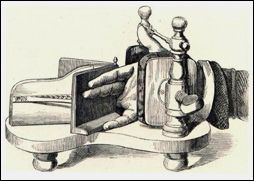
This reminds me of the trend of mechanical devices in the 19th century that limited the range of motion of the fingers for the dubious purpose of “developing finger strength and independence”, but mostly were torture devices that actually crippled their users. Notably, Robert Schumann lost the use of his left hand through using such a device, and was unable to pursue a career as a pianist.

image

2 Likes

The image caught my eye before your post text. “Torture device” was the first thing that came to my mind too lol!

I remember hearing about this in college (I was a music composition major). Certainly a cautionary tale!

2 Likes

Same here. It’s funny how life works out though. Other than hobby type stuff I don’t get to use my degree at all :frowning: But oh well. At least I can articulate exactly why I enjoy Tchaikovsky so much :slight_smile:

1 Like

Yep, I used to do some composing for fun years ago (film score kind of music), but no relation to my current job either. Guess I should be playing classical guitar to make use of all the voice leading studying I did in college.

1 Like

Not a composition major but music certainly. Went to Berklee, now I work in Bio/Pharma.

1 Like

Very cool! I think every aspiring shredder in the 80s/90s dreamed of going to Berklee. I’m pretty much as far from music as you can get as well, a UX designer working in aerospace. (My wife’s actually in Bio/Pharma, too).

2 Likes

It’s funny, I was thinking about posting a topic about a “device” I recently “invented” to help me develop a proper DSX motion when I saw this topic :slight_smile:

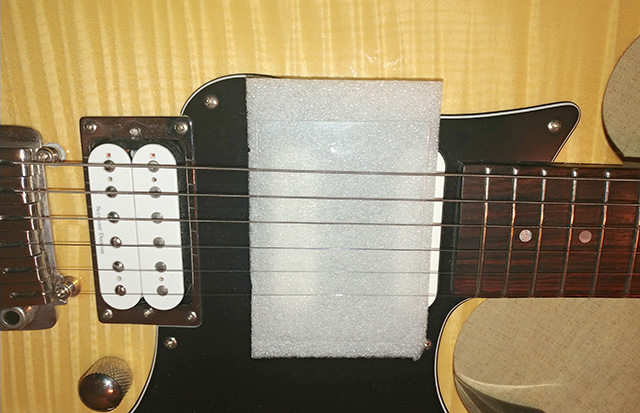
Here’s how it looks.

dsx_trainer

The piece of plastic sheet is inserted between the strings so that only one string (the 3rd at the moment) goes over, while the rest of strings are covered. And the piece of foam behind the strings helps to keep the plastic in place and, in the same time, works as a damper decreasing sound the piece of plastic produces during tremolo-picking the available string. (It clicks awfully loud.)

I’m yet to see if this thing is really helpful in developing picking skills. So far, it lets me achieve fast tremolo-picking tempos in order to try different hand positions and pick grips and find which is the most efficient for me. I couldn’t get to high enough tempos without it because I’m absolute beginner and my right hand can’t keep the same pick depth which totally ruins the smoothness of motion.

Last but not least, the idea to limit picking depth by putting something behind the strings is not mine, I’ve seen it in one of Troy’s videos for which I’m very grateful.

2 Likes

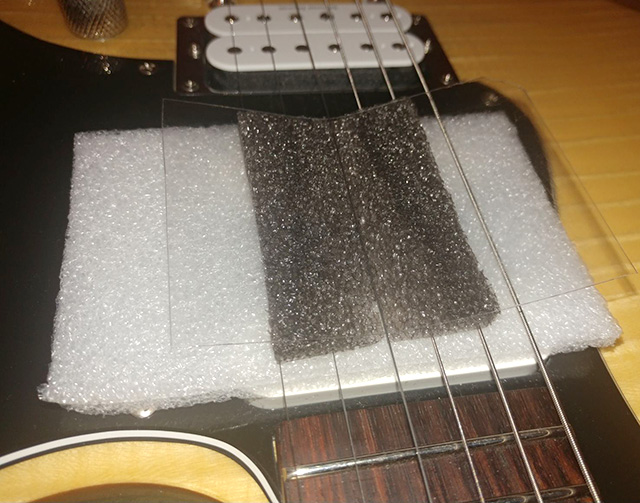
In case someone is interested, I’m testing an updated version of the “training device”. Two foam wedges are inserted between plastic sheet and strings it covers (above and below the exposed string). This bends the plastic and makes the trajectory of a pick closer to the “DBX escape curve”.

This is incredibly creative – looking forward to seeing a video of it in use!

I’ve come to believe that many of the “exercises” that are taught for guitar with the same stated goals, have only the same practical functions as those machines.

1 Like

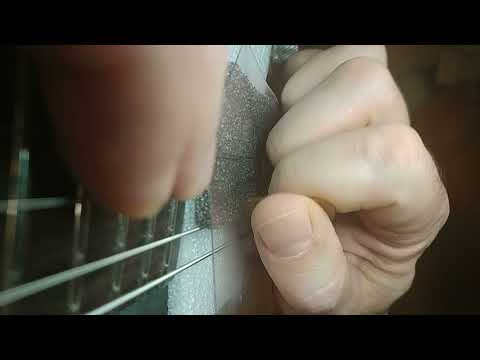
Here you are :wink:

The tests have shown a couple of issues that have to be worked on:

  1. The foam wedges need to be extended to avoid hand “falling” in the direction of the guitar body at higher motion amplitude. (This can be seen in the end of second video.) Although, on the other hand, this lack of support can help noticing that the pick is pressed to the plastic sheet harder than it’s necessary to follow the correct escape trajectory. So, I’m not sure about this yet. Perhaps, I’ll make two sets of wedges: for basic and for advanced training :slight_smile:

  2. It’s necessary to somehow fix wedges in place as they tend to “escape” from their places near the picked string. I guess I’ll add another sheet of thin plastic and glue the wedges to it.

That sounds like a bad idea to me.

If you play basic rudiments for maracas or drums at even moderate speed, or throw darts with some degree of smoothness, you pretty much have to make 902 or an analogous movement with your wrist.

More anecdotally, I really feel like performing some basic patterns with a staff (Upward and Downward Flower) help immensely with picking.

1 Like

Assuming an overhand grip - maracas, drums and dart throwing are 10 o’clock - 4 o’clock movements. They are the mirror motion to 8 o’clock - 2 o’clock (reverse dart thrower). These don’t escape both directions as they are straight line movements. Turning a true reverse dart thrower into the coveted DBX 9 o’clock - 2 o’clock requires a tweak.

Do you mean that just doing the straight line movements on the rhythm instruments teaches us the base motion? I definitely agree once you learn how to do a particular thing with a joint or muscle group, learning similar motions becomes easier.

1 Like

I could be persuaded with some evidence, but I kind of doubt those are straight line movements.

What would be the motivation to have them slightly curved? That seems inefficient. I don’t play rhythm instruments so I’ll defer to your experience over my assumptions : -) I imagine a fast single stroke drum roll as needing to be a straight line.

For whatever it’s worth, my father is a very good drummer and when playing from an overhand grip his wrist movement is a totally linear dart-thrower movement, coupled with some forearm rotation and a subtle action of the fingers which assists in controlling the rebound.

Edit: I’m also willing to bet that the action of throwing a dart smoothly is the motion that the researchers decided to call the dart-thrower motion, which is linear.

1 Like

I thought the DTM traced a shallow ellipse?

No, dart-thrower is radial extension to ulnar flexion. Something like 10:30 to 4:30 on the clock face.

The path is defined by the antagonist group extensor carpi radialis brevis + longus and flexor carpi ulnaris.

The muscles of the wrist have secondary function in forearm rotation, so some subtle rotation may occur during this motion path, but the wrist motion is essentially linear.

The wrist paths which are curved (DBX movements) come from coordinated use of the two antagonist groups of the wrist, being the group mentioned above and the reverse dart thrower group, extensor carpi ulnaris and flexor carpi radialis.

1 Like

Sorry, yes I realized i was conflating DTM and Reverse DTM here.

I was thinking specifically of the feeling of drum rolls and double stroke on maracas. I can’t check it right because my wrists on break, but im thinking it’s reverse dart thrower with some rotation.

1 Like