# General Theory Questions Thread
**URL:** https://forum.troygrady.com/t/general-theory-questions-thread/69780
**Category:** Harmony & Theory
**Created:** [September 16, 2023, 3:29pm UTC](https://forum.troygrady.com/t/general-theory-questions-thread/69780 "2023-09-16T15:29:56Z")
**Posts on this page:** 11
**Page:** 2
### Author:  [@Riffdiculous](https://forum.troygrady.com/u/Riffdiculous)
#### Post date: [March 22, 2024, 9:02pm UTC](https://forum.troygrady.com/t/general-theory-questions-thread/69780/21 "2024-03-22T21:02:52Z")
> [@joebegly](#):
>
> Wouldn’t it just be a Bbm13?
Technically if written like that _all_ of the lower extensions would also be present - 7 9 and 11. Of course in practice that never happens, but it could lead to voicings that don’t quite capture how the chord was played.
> [@joebegly](#):
>
> (not F#, because that’s not part of the key)
Typical jazz nomenclature notes the 6th/13th interval as inherently major (Dorian), even when the chord is minor, so it should be b13.
---
### Author:  [@joebegly](https://forum.troygrady.com/u/joebegly)
#### Post date: [March 22, 2024, 9:24pm UTC](https://forum.troygrady.com/t/general-theory-questions-thread/69780/22 "2024-03-22T21:24:39Z")
I guess I learned it wrong then lol! Which doesn’t remotely surprise me. I’ve just synthesized that stuff from reading various published things. My education was classical and they don’t often use chords that adventurous. Plus, that was a lifetime ago.
Thanks for explanation! 👍
---
### Author:  [@Riffdiculous](https://forum.troygrady.com/u/Riffdiculous)
#### Post date: [March 22, 2024, 9:30pm UTC](https://forum.troygrady.com/t/general-theory-questions-thread/69780/23 "2024-03-22T21:30:22Z")
It’s just like how 2 out of 3 major chords in a key have a major 7th, and yet the designation of just 7 (like C7) implies it’s dominant. You have to add extra crap (maj7, or a triangle) even though technically it occurs more frequently. It’s the ii V superiority bias. lol
> [@joebegly](#):
>
> My education was classical and they don’t often use chords that adventurous.
But you have figured bass! 😉
---
### Author:  [@aliendough](https://forum.troygrady.com/u/aliendough)
#### Post date: [March 22, 2024, 11:03pm UTC](https://forum.troygrady.com/t/general-theory-questions-thread/69780/24 "2024-03-22T23:03:33Z")
> [@Riffdiculous](#):
>
> Typical jazz nomenclature notes the 6th/13th interval as inherently major (Dorian), even when the chord is minor, so it should be b13.
this is something i didn’t know - thanks. 🙏
---
### Author:  [@aliendough](https://forum.troygrady.com/u/aliendough)
#### Post date: [November 8, 2025, 8:45pm UTC](https://forum.troygrady.com/t/general-theory-questions-thread/69780/25 "2025-11-08T20:45:48Z")
ok, I have another one. it’s quite trivial, so I dont want to open a new thread for something like this.
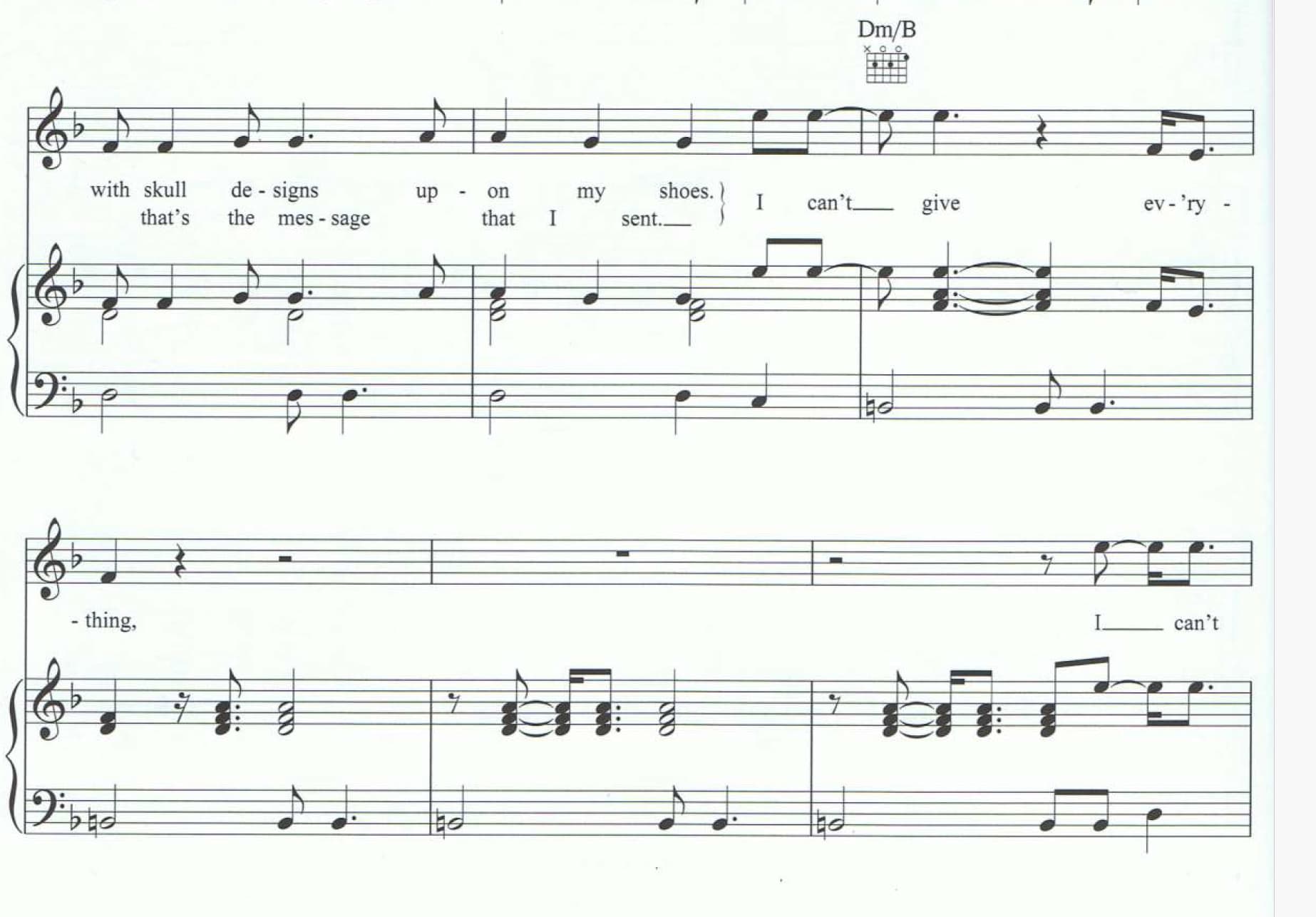
I have the sheetmusic for David Bowie’s Blackstar album, and I notice that a chord in “I Can’t Give Everything Away” is notated as Dm / B. Why would this not be notated as Bm7b5, which has the same notes (I think…), right??
I have seen this in other sheet music before, and always meant to ask but never did!!
---
### Author:  [@Riffdiculous](https://forum.troygrady.com/u/Riffdiculous)
#### Post date: [November 8, 2025, 9:30pm UTC](https://forum.troygrady.com/t/general-theory-questions-thread/69780/26 "2025-11-08T21:30:55Z")
> [@aliendough](#):
>
> a chord in “I Can’t Give Everything Away” is notated as Dm / B. Why would this not be notated as Bm7b5
Ok, so this is a little wonky, but because this is the key of F major, Dm is the correct name, as that’s the vi chord - there is no Bm7b5 in F. You can put whatever note you want as the root in a slash chord, diatonic or otherwise, without changing the chord name.
But, looking at the piano score, the chord chart, and listening to what the guitar is actually playing in the song just now (cool tune), this is one of those “tricky to give a satisfying name to” chords. What is the point of naming a chord? To relay what the chord is easily, without spelling it out, but that doesn’t work in all situations.
I briefly mentioned it in this thread over a year and a half ago (!!!), but there is a chord Al Di Meola plays in Orient Blue that sounds gorgeous: low to high, Bb F G C E. There’s just no “normal” way to name it - It’s a poly chord.
---
### Author:  [@aliendough](https://forum.troygrady.com/u/aliendough)
#### Post date: [November 8, 2025, 10:44pm UTC](https://forum.troygrady.com/t/general-theory-questions-thread/69780/27 "2025-11-08T22:44:58Z")
Thanks again - I undestand now. As I said, I had always wondered about slash chord names in charts.
Now that you have explained the fact that it’s a simple case of no Bm7b5 in the key of F - it’s all obvious! 😂. I slipped up on that one.
---
### Author:  [@Prlgmnr](https://forum.troygrady.com/u/Prlgmnr)
#### Post date: [November 9, 2025, 7:46am UTC](https://forum.troygrady.com/t/general-theory-questions-thread/69780/28 "2025-11-09T07:46:22Z")
The old old jazz guys apparently used to name that chord as a minor triad over a 6th in the bass as opposed to the minor seven flat five built off the 6th degree of the scale which was terminology that came in later, Dizzy Gillespie mentions it in an interview somewhere.
Another reason for using slash chords is when the movement of the bass note is important and you want to ensure it gets played, or you are trying to specify a specific voicing.
---
### Author:  [@aliendough](https://forum.troygrady.com/u/aliendough)
#### Post date: [November 9, 2025, 1:41pm UTC](https://forum.troygrady.com/t/general-theory-questions-thread/69780/29 "2025-11-09T13:41:40Z")
> [@Prlgmnr](#):
>
> Another reason for using slash chords is when the movement of the bass note is important and you want to ensure it gets played, or you are trying to specify a specific voicing.
Let’s say for argument’s sake this is a Bm7b5 chord. If the chart simply said Bm7b5, this would mean it would be up to the musician playing it as to what inversion to use, is that right? They might the D in the bass. In this case, the chord is written in such a way so the B is played as the bass?
---
### Author:  [@Scottulus](https://forum.troygrady.com/u/Scottulus)
#### Post date: [November 9, 2025, 6:20pm UTC](https://forum.troygrady.com/t/general-theory-questions-thread/69780/30 "2025-11-09T18:20:13Z")
> [@aliendough](#):
>
> Let’s say for argument’s sake this is a Bm7b5 chord. If the chart simply said Bm7b5, this would mean it would be up to the musician playing it as to what inversion to use, is that right? They might the D in the bass. In this case, the chord is written in such a way so the B is played as the bass?
It could also be for the sake of the people with whom you are trying to communicate this chord to. Ie what are the chances they actually _know_ a Bmin7b5 chord? Not everyone does. But they certainly know a Dmin, and if playing with a group the bass player will play a B, while the guitarist who doesn’t know what either a Bmin7b5 OR a Dmin/B is, they will most certainly catch the Dmin and play THAT and it will be _mostly_ correct in that it will sound right for the most part. Food for thought.
---
### Author:  [@Fossegrim](https://forum.troygrady.com/u/Fossegrim)
#### Post date: [November 12, 2025, 3:11am UTC](https://forum.troygrady.com/t/general-theory-questions-thread/69780/31 "2025-11-12T03:11:18Z")
> [@aliendough](#):
>
> > [@Prlgmnr](#):
> >
> > Another reason for using slash chords is when the movement of the bass note is important and you want to ensure it gets played, or you are trying to specify a specific voicing.
>
> Let’s say for argument’s sake this is a Bm7b5 chord. If the chart simply said Bm7b5, this would mean it would be up to the musician playing it as to what inversion to use, is that right? They might the D in the bass. In this case, the chord is written in such a way so the B is played as the bass?
Depends. On a basic lead sheet, yes it can be up to interpretation which voicing you used or whether figured bass plays a roll in that decision. This is usually taken as a rough abstract that someone say a session player can use some discretion with.
However if this transcription has a distinct movement and voicing implied, than it has an intended use case of Bm7b5 in root position if B is the implied root note of the chord.
[Previous page](https://forum.troygrady.com/t/general-theory-questions-thread/69780.md?page=1)