Hi, Everyone. I think I stumbled onto Dart Thrower motion. Or at least I think it is. It feels like it. I show it and talk about it in this video. I just wanted to make sure it was really dark thrower, lol. Thanks!
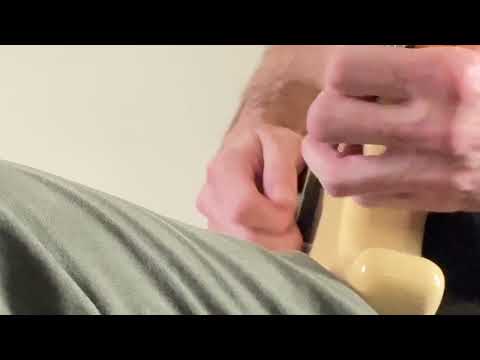

Hi, Everyone. I think I stumbled onto Dart Thrower motion. Or at least I think it is. It feels like it. I show it and talk about it in this video. I just wanted to make sure it was really dark thrower, lol. Thanks!
Try it with a trailing edge grip and you get real close to Shawn Lane style speeds.
This is my go-to picking motion, although I prefer to use a leading edge grip because I prefer the tone I get from it. I can even get DBX from this position by using trapped downstrokes most of the time and then quickly switching to wrist deviation when I want to escape on the downstroke - although this is much harder for me with the trailing edge grip.
I’ve yet to watch the entire video, but I must give you immediate props just for the shirt. He’s among my top favorite composers.
Hi, Tom. Thanks so much for letting me know! It felt like it would be that motion, but I really appreciate you confirming it. It’s such a fun motion. It’s really kind of very unique feeling when using it, but it’s very fun to play. Thanks again!
Hi @Bill_hall . No problem, glad to help.
It’s my favourite motion, too.
I was reverse dart-thrower player since I was about 15 years old. I developed mixed-escape alternate picking, double-escape and USX systems all based around RDT.
I started training the dart-thrower movement during the pandemic, after I was able to identify the movement in Shawn Lane’s playing. Within a couple of weeks, it was faster than the RDT based movements I had been using for half of my life. I already had a lot of USX vocabulary, so it was pretty easy to transition to DT.
I made a video about the movement for the forum here:

More recently, I discovered the rotator-cuff and elbow USX movement, which pairs really well with dart-thrower. I dislocated and tore my right shoulder a few years ago. This movement has actually helped to rehabilitate my shoulder, but I’ve had to learn to implement it more gradually.
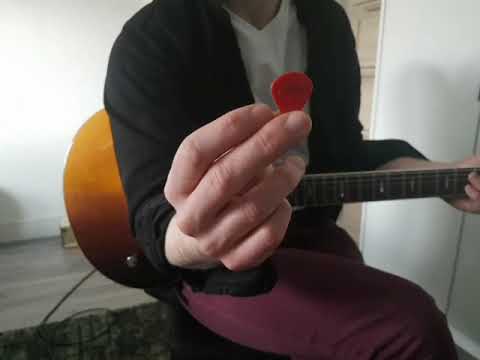
Yeah, the technique just naturally facilitates those kinds of speeds. It’s ridiculous.
I prefer the tone I get using the leading edge grip for medium to fast speeds, too.
Thanks so much for the videos, @Tom_Gilroy. I appreciate you sharing them with me! Do you have any videos of you playing lines with dart thrower motion? I think that would be really neat to see. What part are you anchoring when you do it and where is the motion generated from? Thanks again and I really appreciate it. 
I’m happy to.
Not that I can link to right now. I have a lot of footage of my playing in lessons, but I’d need to sort through them and make clips.
If you’d like, we can schedule a chat over Zoom, if there’s a time that suits you. I’m on Irish time.
I have basically zero knowledge/skill in video recording and editing, but I can make a rough video demonstrating if Zoom doesn’t suit you.
I don’t like the word “anchor.” I don’t apply any pressure into the guitar, contact is for damping and tactile reference only, not for support.
That said, my wrist lies pretty flat across the bridge/strings. The thenar muscles (thumb muscles) touch the lower strings, but the ulnar (pinky) side of my wrist near the pisiform bone is also in contact with the bridge. The ulnar edge of my palm (karate chop area) doesn’t touch anything.
The movement is the hammer movement you demonstrated in your video, but I also incorporate some rotation on accents.
Cool video! Yes I agree with @Tom_Gilroy It looks like DT. You and I have discussed this before. I think the pentatonic examples in your interview, when you use more wrist technique, are this as well. I can see that this form looks more snare-like. So it may be a tweak on what you were doing before. But the more general idea of getting upstroke escape from this type of wrist motion – I think you’ve been in that lane for a while now. Don’t worry, we won’t hate for your “guy who casually learns all techniques” superpowers!
i watched one of your videos on deviation and thinking of it as a clock. im really trying to master 2 way pickslanting. i was experimenting and it feels like switching between picking motions when switching strings feels smooth. so when i start out with a 3 note per strong i us 2 o clock ds 7 oclock, then the opposite on the string skip so 11 to 4. i was wondering if this is efficient. even with 2 note per string?
The clock face stuff is just a way we came up with to describe how the wrist works. Not everybody even uses wrist motion, so I wouldn’t worry about trying to “math” your way into learning a technique by thinking about things like a clock.
Instead, if we step back a minute, the most important general goals are: fast, smooth motion on a single string; then chunking; then hand sync; then, at minimum, the ability to do evens patterns across the strings at lead-playing speed.
Once you have all that in place, and it’s repeatable and sounds great, then I’d worry about 2wps.
Do either of you have any tips on maintaining the motion while doing it with leading edge? I think I worked out how to do the Shawn Lane USX version with a trailing edge last week, it’s stupid fast and when you are just thinking tap tap tap instead of the individual pickstrokes it doesn’t even feel difficult.
I fire it up trailing edge and try to rotate the pick in my hand to leading edge while maintaining the speed but I’m having mixed success at the moment 
I’ve been playing around with this too, and I think I got a start on it. It required me to pronate my picking hand much more than I’m used to, and rest the palm of my thumb (abductor policies brevis) on the strings so that a dart-throwing motion creates a downstroke-trapped pickstroke with a leading edge grip. I’m not certain I’m getting it exactly the way Bill or Tom do it, but so far it’s very fast, stable, and low-tension outside of the pronation. I’m still refining, but I think I’m going in the right direction.
Sorry I’m not more help. I’d love to hear from someone more experienced in this as well.
My position is slightly more supinated with the leading edge grip than with trailing edge. This gives enough of a downward slant to avoid garage spikes with the USX motion. The grip is quite loose and allows the pick to “flop” slightly, the movement gets sticky if I grip too tight with leading edge.
Look at that video I had made for you again. If you need a more detailed demo, let me know and I’ll record a clip for you.
Yeah, it’s ridiculous. Super fast and easy.
Within about two weeks of training it was faster the RDT based USX movement I had been using for about a decade.
I wasn’t able to perform the movement with a leading edge grip right away, either. It took a few weeks of familiarity with the trailing edge version for me to be able to stay connected to the movement with leading edge. Before that, I kept reverting the the RDT-based USX movement I had previously trained.
The trailing edge version is faster for me, I can do it basically as fast as I can move my hands. The leading edge version is a bit slower, but still easily hitting 200 bpm.
Thank you Tom
I’m trying to morph it into a version where I can do DBX for my Bluegrass playing as I don’t really listen to shred much these days but the movement is just so capable it has been fun going back to some of that repertoire.
Yep that has been my experience as well, I can do 140bpm 16th note triplets with it easily and 160bpm 16th note triplets with a little more focus but it feels like it has the potential to go faster which is blowing my mind. For context, my old FW motion would max out in the 130s but with more effort involved.
The hardest part was just initially syncing it to the left hand and getting past how weird the pick attack feels, especially when going slow but I was watching Shawn demonstrate stuff slowly on Power Licks and it still sounds super smooth.
Glad I’m not alone, I have been messing around with the movement a little but after watching Bills video.
When I get it working it feels like a much easier variant on my standard RDT motion.
If anyone has any footage to share, I’d love to have a look to see how you’re amking DT work, looking at you @Tom_Gilroy and @Jacklr 
I mostly use my RDT form (902 movement) for DBX, or more recently rotator cuff and RDT on acoustic guitar guitar (like Billy Strings).
I was surprised to find after learning the Shane Lane style dart-thrower movement that I could do the Molly Tuttle or David Grier style of DBX almost immediately, despite having failed to learn that movement on several previous attempts.
For me, the key for DBX (as opposed to leading edge USX) was actually to pronate more than the Shan Lane form with the leading edge grip to achieve a upward slant, and then accepting some deflection from the string when playing downstrokes. So, the upstroke “slides” along the string, and the downstroke deflects away from it.
Yeah, the difference is incredible. I could maybe get the RDT form I used for USX and mixed-escape to about 16ths at 225 or sextuplets at 150 on a good day, but 16ths at 210 or sextuplets at 140 was probably more representative of the capability of the technique. I thought for a long time that this was my “genetic limit”.
Even the slower leading edge form of the DT USX movement hits those speed easily, and the trailing edge form goes faster than I would ever need. I don’t even care enough to measure anymore.
What pick were you using for trailing edge? I felt pretty much the same, until I tried out a jazz pick instead of 1.14mm tortex.
A Jazz III and then a Dunlop 2mm Big Stubby and a few things in between; I find even the Jazz III to be a bit too clicky in tone for my taste.