
Some thoughts on picks

Ok. I’ve become curious recently. So I decided to make some experiments. First thing that I was interested in is the difference in sound when playing with/without edge picking.
So, I recorded some note with flat picking and with exxagerated edge picking. While difference is not so large with distorition
https://vocaroo.com/i/s1JsyqpGCouq
it’s more noticable with clean sound
https://vocaroo.com/i/s1ZxkFFKihva

This ‘click-click-click’ sound… for me it’s more obvious with edge picking. Ok.

So, this is how these two records look in comparison
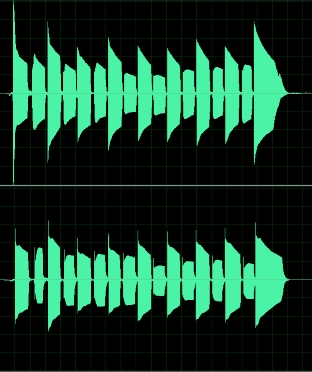
pic1_compare

Upper waveform - flat picking, lower one - exxagarated edge picking. Well, visually they differs. With moderate edge picking the difference is not so noticable. So, I started to search that thing that gives this click sound… and I found it but not where I’d thought I’d find it.
First, there was no click in the begining of first note. There was a typical attack but not this metronome-like click. I recorded one more take, then one more and one more - no click on first note.

The interesting thing that although I didn’t use muting you can clearly see the pauses between notes. Seems like they are the moments when pick comes to contact with string. So, for a short period of time string stops to vibrate… or does it?

The most interesting thing is the waveform after every note.
Here’s the looped part of a note. Analysis recognize that it’s a C# (about 546Hz)
https://vocaroo.com/i/s0Nf3tcSbT6H
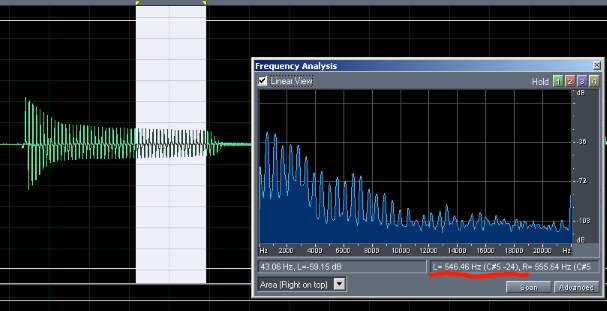
pic2
Ok, it’s just a note.

And here’s the looped part of a “pause”.
https://vocaroo.com/i/s0EsVxdF3SvM
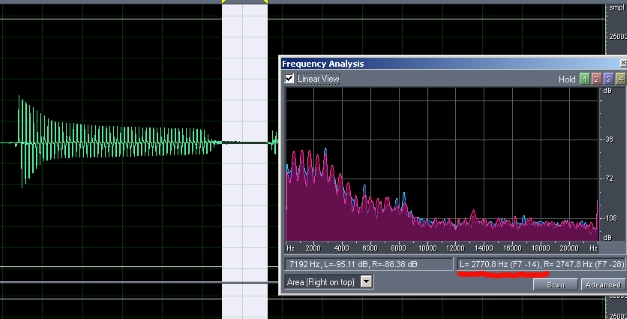
pic3

This is our ‘click’ sound. Analysis recognize it like 2.7kHz which is too high to be a regular guitar note. Interesting thing: zooming shows that it’s not a noise. This “pause” sound is quite harmonic
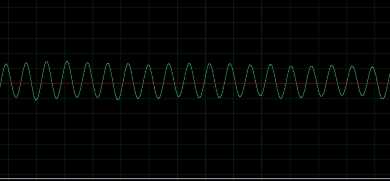
pic4_pause_zoom

So, what is this sound? I was thinking about it and then… ‘Wait a minute!’
I measured the distance between the bridge nut and the place where I pick the string. It was about 3.2". Ok. My Yamaha scale length is 25.5". First E string has frequency 329.63Hz… So, 329.63x25.5/3.2 = 2626. Yep… This is it.

When pick touches the string it doesn’t mute it completely. The pick serves as a fret instead, making the string produce short high frequency sound. Interesting. What could we learn more from these waveforms?

Edge picking waveforms has shorter ‘note’ and longer ‘pause’. Ok, this may explain why that click sound is more noticable with edge picking. Additionaly, my upstrokes has different attack. While flat picking upstroke sound starts as it should, edge picking sound has some fluctuation in the begining.
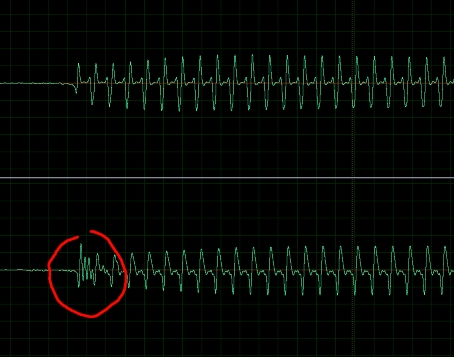
pic6v2
My guess was, that it’s the result of the pick sliding along the string (which happens when you use edge picking). Its length is too small for internal software analysis, so I simply found it’s frequency by measuring it’s period. It was about 2.3kHz.

So, edge picking really makes different sound.
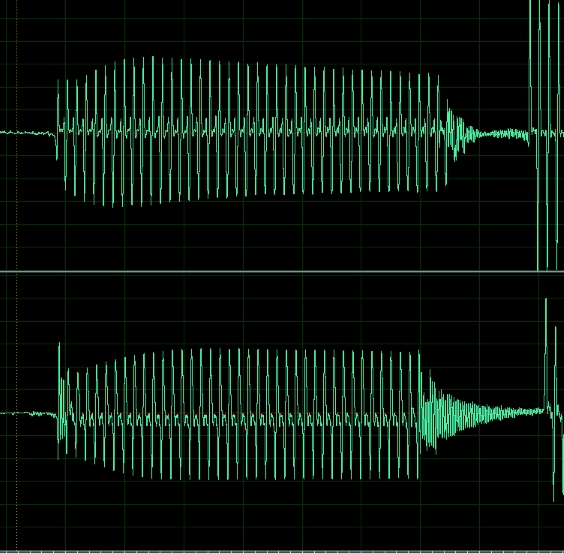

You can see and you can hear differences in upstroke attack phase, and in decay phase. Well, may be these differences are typical for me only. I don’t know. Experiment is to continue…

9 Likes

This is awesome! Excellent detective work here. What is your background?

This is what someone else here has called the “chirp”. And the pitch will be different on the downstroke vs the upstroke because the contact is at different spots on the string. The pause phase between the notes, and potential sliding, I hadn’t considered.

Bravo

2 Likes

Thank you @Troy ! Your words really mean a lot to me.
Background? Do you mean my education? I’m a certified food production equipment mechanic ))
Although I’m very curious about things around me.

1 Like

With several around the house, I can attest to the Stylus Pick yanking on the strings when it catches. I completely abandoned it when I went to the grosser movements with increased accuracy implied by DWPS and edge picking. Kind of fun to play with. May or may not have helped my strict alternate picking development. I tend to notice that “fussiness” regarding depth of pick introduces more strain, mentally and physically, with regard to the practice tasks at hand.

1 Like

It revealed that I was wrong about Stylus Pick. As Troy explained to me its inventors had another goals, not easyfiyng the picking process.
I’ve just edited the first post.

Everyone in the office now thinks this the coolest job ever. What kind of equipment do you work on? Personally I hope it’s the glazing machines they use at Krispy Kreme.

3 Likes

Hi @ASTN.

Great thread and interesting analysis.

I had mentioned the idea of the pick acting like a fret when making contact with the string earlier in the Roy Marchbank thread.

I wrote the following:

When making initial contact with a string, a very hard pick will will effectively sound a note determined by the picking position (similar to a slide touching the string or Bumblefoot’s thimble-tapping technique), before it pushes through the string and sounds the intended note.

As most people pick somewhere between the fretboard and bridge pickup, the resulting non-musical pitch is very audible when playing on the bridge pickup.

I can’t perceive it with a nylon pick unless I’m picking a string that’s damped with the left hand. I perceive it more clearly with something like ultex, but it’s still in the realm of what I would consider “attack” when note are being fretted. With lexan (the material stubby picks are made from), the non-musical contact pitch is very noticeable to me on every picked note, and I don’t like it.

I think some people call this “chirp."

3 Likes

When you say this I start to think that that kind of job is really fun ))

I wish )
Well… truth is, despite my education, I work in another field (that is typical for my country). I found some quiet easy job that doesn’t require a lot of energy. So I can spent that saved energy learning new stuff, playing guitar or soldering some strange things.

3 Likes

Experiment has shown that you were right… well, at least with me playing ))
You woke up my curiosity again. I’ve just tried to record edge picking sound on my neck single pickup. Yep, ‘chirping’ is not so audible, which is logical considering the position of a pick, bridge, and pickup. However, I can still see it on waveform, although it’s amplitude is significally lower than in the case of bridge pickup.
Fun thing, I still can’t decide - whether I like this ‘chirp’ or not. I guess it’d depend on current musical material.

I’m going to pretend you said “Donut City” for maximum 80s nerd points.

2 Likes

Loving all these investigations. Great work!

2 Likes

Loving the pick data collection. Science! Where will it end? Electron microscopy? I wouldn’t put it past this community to come up with some evidence that way. :slight_smile:

That’s what you get when you have a guitar but you can’t play well and you’re too lazy to practice )) Just pretend you’re doing science!!

2 Likes

Hi @ASTN.

I would suppose that the chirp pitch has to exist to some degree, regardless of the pick material or pickup setting. How perceptible the chirp is would certainly depend on those factors, and probably other factors too.

Some players have told me explicitly that they enjoy the chirp. Others don’t seem to notice it at all.

Cool break down of the chirp ! My belief is that pick material adds to character (harmonic resonance) of the chirp and the string vibration. The gauge, added with the type of strike and or dampening of flesh also contributes to this. I can take a crappy acoustic, select the right pick, determine whether pick gauge should play lighter or harder, and I can make the guitar sound more pronounced in where it was lacking. I think that is what Eddie Van Halen always made blanket statements, like it is all in the hands…yeah and the pick!
Oddly, light strings arguably have better tone in higher gain tones where heavy gauge typically sounds better on light overdrive as in SRV - but that is a whole other can of worms. In my view, the more the solid state gain or excessive 12ax7 pre amp gain or pedal drive/distortion or hotter pickups to active pickups… the less the impact of your manual control has on wood resonance of the guitar and other characteristics. A pick chirp at 8K post treatment, with a certain blend of mics and combo of room and speakers, with SSL, 1176 and other style comp/limiters may be exactly what sound amazing in the context of a mix of a particular song, but sound not so great alone. These studio tools, shape the character of the sound, of what’s already there… they can do no more. I believe through the sum of its parts, including pick material and great playing, you can impact the character of the chirp and overall tonal character to a degree, thus helping make that 8kHz pick chirp less brittle when Chris Lorde D’Alge puts your guitar tracks through his preset, CLA filtered sound - nothing against CLA! haha

Damn @ASTN, you are really smart guy to investigate all this stuff. I have never heard of anyone thinking about or doing this before. This is really cool and interesting even to me as a layman.

@aliendough thank you for your kind words! You know, I just have a good example to follow. I think we all know that guy with analytical mind and incredible guitar skills, who created this forum ))

1 Like

Strings are under tension and have elasticity, when you push down the string it pulls against your pick angle by increasing the stress on your fingers to a greater level depending on the distance of displacement and the status quo would change.

The pick material and the strings both have low grip properties to easily slide over each other depending on which element gives way first.

If you pick in a decisive action then the string would be shocked into waves, the string length will be effected through rippling and the splash back would knock on the string on return. The lowest note of low E is 82Hz of kickback speed.

I like the animations but the materialistic properties and conditions aren’t accounted for and I would only see the animations being accurate on a floating bridge playing at >80 notes per second with a metal robotic arm and pick

2 Likes

Animations were a demonstration of different conceptions, not of a physical models. And for now, at least in my experiments, I see that these conseptions are correlated with real world. I gladly would see your thoughts on this topic. More opinions - more fun!

What a cool thread. I was struggling with just this “chirp” using pickboy agate stone picks.

I love the picks and the tone but that chirp was a bit much on the high E string, was more of a clang with YJM style single string licks under high gain!

In the end gave up and went back to Jazz III XLs.

2 Likes