Hey there - I’ve really been exploring the 4+2 scalar geometry a la Metronomic rock as of late. Anybody made some interesting discoveries along these lines there that they might want to share?
EDIT;
Here I am, with another instalment of “bore everyone to death” - Thought I’d write a bit about how I went about learning these scale shapes - maybe someone finds it helpful.!
So getting used to the err “geometry” of this approach is taking some doing. A bit of LH stuff and RH things to get used to; certainly a lot different than the regular “3NPS” or “in position” scales we’re all used to. My strategy starts with familiarity first and foremost - I consider scales an scalework in general to be a “pool of notes to draw from” so getting my brain and my instincts acclimated to this 4+2 idea is helpful in an “additive” sort of way - it’s just another way to get to know the neck in a different context. One that is conducive to how I pick, DSX, even notes per string (Although of course the even ups thing works for USX!)
So my first steps are this; 1) Learn the damn scale fingerings in one key (C Major is a good starting point). Don’t worry about speed initially - that will come later, I know that this note layout will be successful being played quickly so speed development isn’t a priority - familiarity is.
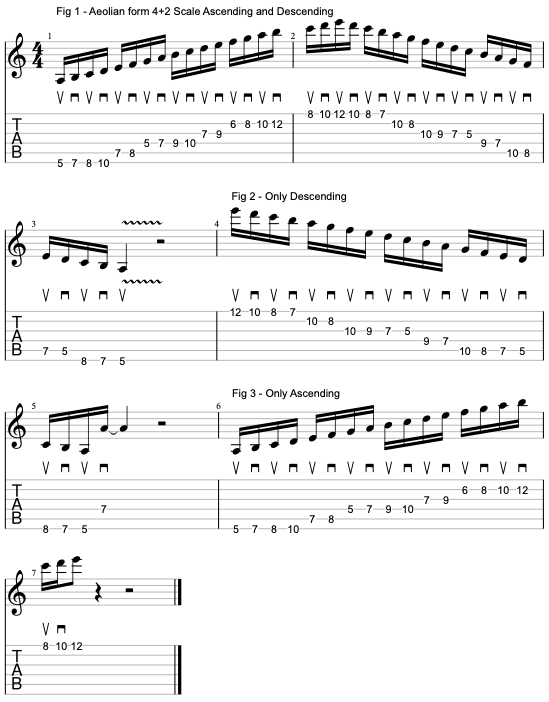
2) Pick a fingering to focus on and get “good at”. I’ll start with C major starting from the 6th degree, or you could call it an Aeolian layout I guess. practice as 16ths ascending and descending, and in all 12 keys. I like to go in cycle of 4ths and pay attention to the actual notes in said keys. So thick this;
CFBbEb AbDbGbB EADG
3) Same as number 2 all 12 keys in cycle of 4ths - only descending from the high E - Basically the starting note is the 5th, so you need to know what the “5th” is of each key. Key of C, starts on a G, key of F, starts on a C, key of Bb starts on an F etc etc. This way we aren’t chained to just root notes, and we have an additional reference interval getting burned into our minds from with in the scale geometry.
4) Same as number 3, only ascending. Root notes are easier so I leave the easy work to the end.
This gets me started on getting used to new pathways. There’s more stuff I do to get used to a new chord/scale/arpeggio/sequence or whatever but this is a good starting point I find.