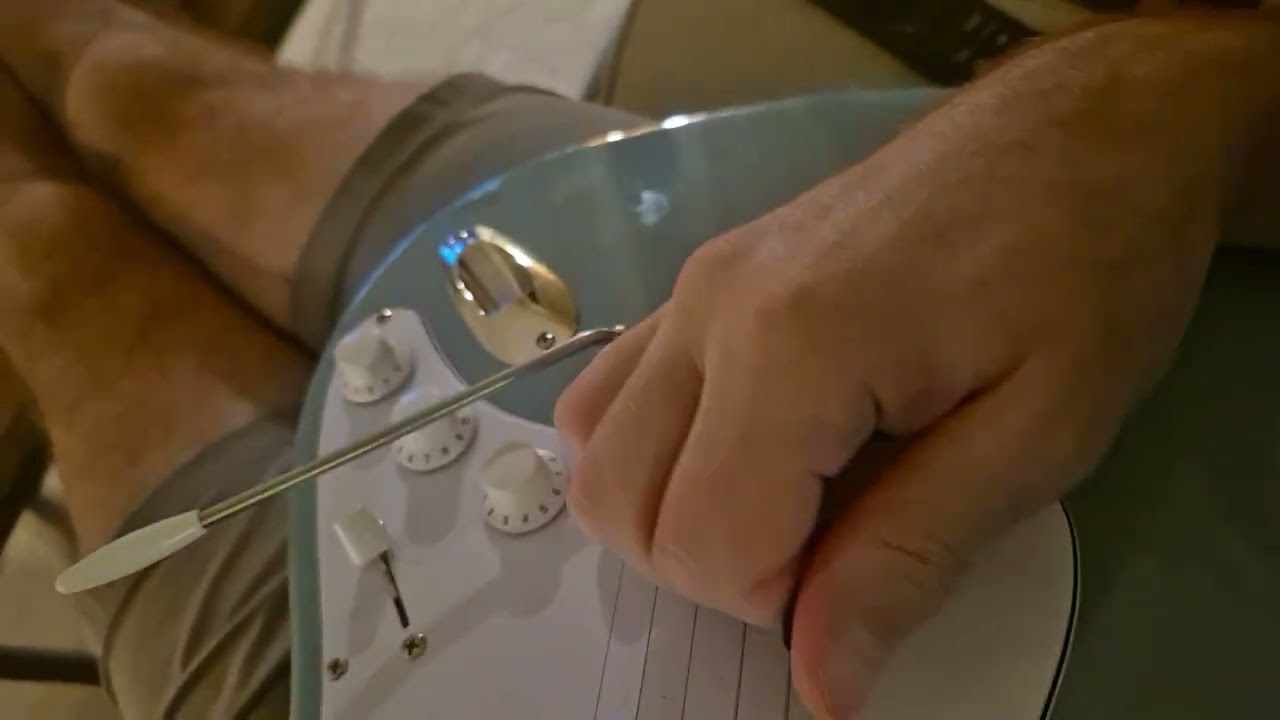
DSX player here. Everything falls apart on the low strings, especially the low E, especially when muting, ESPECIALLY on tune-o-matic or arch top bridges.
With my DSX hand position, the contact point with the guitar is the base of the thumb and the thumb side of the heel of the hand. And on those kinds of bridges when I’m positioned to play the low E, there’s no bridge left to rest on. My hand is just hanging out in the breeze in thin air. And if I try resting on the guitar body, it’s so much lower that the angle of the hand totally changes so you have to build a while separate technique just to play the low E.
I want to play metal so alternate muted picking in the low E is key to everything. I’ve been trying crazy stuff like building hand rests above the low E strong on the body so there’s something to rest on to maintain the consistent lateral hand angle used when playing the higher strings.
Video is going to help. Even better would be to post a technique critique and see what CtC says. I am guessing solution is probably to supinate your forearm more to allow more flesh anchoring and allow for palm muting because you could be overpronated towards thumb
These are the worst. lol I have adapted to playing on a TOM, but I’ll always prefer bridges that are lower to the body.
I think it’s important to understand why it’s an issue - what’s happening is the loss of support while playing the lower strings causes picking depth to become extra difficult to control, so picking the string is now “hard”. The key is to find some other way to support.
One possible solution: Andy James used to play on a TOM back in the day, and you can see that in his faster playing he always presses his ring finger into the body of the guitar, so that’s his form of added support.
Two other guys to look at are old videos of Al Di Meola and John McLaughlin. Al played a Les Paul, and John an SG. I’m not sure offhand how exactly they went about playing on the low strings, but they certainly had no issues, so that can also be a route for you to explore.
Hey there, fellow DSX low-string sufferer. Yes, this is my bane as well, though my issue seems to be less about the bridge and more about the lack of string “below”. It seems like it provides my body some kind of guidance that, without it, turns everything into pure crap.
I definitely use @Riffdiculous’s solution from Andy James. One other thing that I do when using DSX motion on lowest strings is a similar technique to @milehighshred, aka the Metronome Method, which is anchor/touch point on thumb side of hand with big extended wrist for Dart Thrower motion. This is also the setup I use for fast downpicking like Master of Puppets.
I will also change between this and more classic USX wrist setup to engage different muscles and stave off fatigue.
This is all detailed in the Obsidian seminar’s first lessons
Hey there! I also struggle with this exact issue, it’s this issue that lead me to join ctc in the first place. I mainly wanted to comment just to help draw some focus to this thread.
I’m still working on the “solution” but for me it seems that the only way forward is to try and develop a USX technique to tackle the low palm mute metal rhythm style. I just feel like personally DSX is great for leads and soaring, non palm muted stuff, but USX shines on low string chugging. I’m making some progress but still have a long way to go training my brain to latch onto USX and bounce back and forth between that and my normal DSX style. It’s tricky stuff
I think the challenge is that they are RDT players whereas OP apparently tends to play DT.
I had a similar problem and adapted by allowing the joint in my thumb to touch the body when playing the 6th string. You don’t really need a really strong anchor rather than a slight physical touch to remain balanced.
I see it similar to performing a yoga position supported on one foot only. Chances are that slightly touching a wall with one finger would be enough for you to remain in balance.
Really glad to have found this thread because this is my perennial struggle too. Like @curvy my contact point is the thumb heel primarily. My default for playing the low strings on lower bridge guitars seems to be to roll the hand so that the thumb heel is contacting the body for the lowest strings, but at least for my hand anatomy this seems to be thoroughly incompatible with Tune-O-Matic style bridges. Whenever I pick this way on a TOM bridge I’m basically banging my thumb and pinky heel joints into the extra tall pickup ring and the high corner of the raised bridge over and over again at warp speed, and it feels pretty awful. I’m apparently most used to playing on trems, so this feels both pretty alien and pretty painful. The problem is, I kinda fell in love with a PRS McCarty 594 recently and that has a Tune-O-Matic style bridge, so it’s prompted me to re-evaluate my technique to see what I can do about it.
I think what I find challenging isn’t so much continuous palm muting on the lower strings, but more: doing open note stabs in a palm muted line, staccato, and really syncopated playing (with rests or dead notes). Really anything where you have to rapidly transition from open to muted many times over. I can’t figure out where to rest my hand on Tune-O-Matic style bridges, or how to orient my hand and forearm, to make this feel fast, consistent, and fluid.
My options seem to be:
Accept that Tune-O-Matic style bridges just don’t agree with my picking technique and hand and move on. I don’t want to accept this though - I’d be missing out some really, really awesome guitars I’d really like to be able to make work for me (like the McCarty 594).
Retrain my right hand technique to just make USX my primary. I’ve tried it, and it seems like I might be able to make the switch for single note lines and palm muted chugging, but my brain just cannot comprehend 2-3 string strumming with USX motion. It’s just 100% garage spikes on the upstroke.
Retain DSX, but change the primary contact point to be the pinky heel? I haven’t quite figured out the right forearm positioning / rotation for this to be possible tbh.
Really not sure if there’s anything I’m missing / anything else worth trying.
I prefer low profile bridges for this reason as well, but to be honest I have no issues on my archtop with TOM.
Possibly a silly recommendation, but if you play lots of metal rhythm you will adapt pretty quickly as you’re on the low string a lot, and you also need to be able to mute as well.
That’s not silly, it’s a great tip. Playing the verse rhythm to Smoke on the Water helped me strength my USX when I was working on it. Helps with crashing through the strings in rhythm while still muting. The same will apply to DSX.
This is a great idea and more or less what I’ve been trying to work on (forgot to mention that most of my struggles on TOM bridges have been with playing full songs, not just soloing), but I think I haven’t found the right practice songs yet. Apparently nothing in my current repertoire has enough quick muting & unmuting going on to feel like it’s really training anything. Off the top of my head Creeping Death might not be a bad practice song here?
There are so many good options but a good place to start would be something like Leper Messiah. Not crazy fast (around 175bpm) but a lot of low E focus
Creeping death is another good one, but it’s pretty fast!
I too am “solving” the issue by trying to find a USX movement. One thing that makes me absolutely insane is that on several occasions I’ve “found” a movement. Take last night, for instance. Watching TV, guitar in my lap, *bang*, a motion falls into my lap. It’s not perfect – for example it gets wobbly at the highest speeds – but it feels like a motion that could be banged into shape and usable. I mess with it all night, get it better, work back and forth to my DSX, get a little scared when I put down the guitar for a second but I’m able to get it going again. I guess I should mention that while I was working through these, I was also able to use my DSX motion on the low E string at times. Everything was clicking.
Get up today and it’s gone.
Last night it felt so natural. Like of course that’s going to work, it’s easy. It’s right there. Now I can’t do it. This has happened to me so many times, over years. It’s just so frustrating and demotivating. This is what makes me step away from the guitar because it just infuriates me.
I’ve said this before, but I think everyone needs to take videos and notes when a breakthrough happens.
At the very least, a video of how you’re holding the pick, and maybe another video that shows your body ergonomics. Talk to the video and mention what cues are working, the feeling of the pick attack, the force you’re applying, etc. Depending on your other activities, note what you did beforehand (did you just lift? Spend some time tightening some screws on furniture? Etc).
I find most people are apprehensive on doing this for whatever reason, but I think it’s the best way to try to capture when something clicked.
Honestly, not really . Even looking back at them I can see how utterly insufficient they are. Hopefully I’ll be lucky enough to find it again and be better about documenting.
EDIT: Well, I ate my pride and recorded what I hoped would capture the attempt better. I’m “finding” it more often and sooner, but still have to hunt.


 . Even looking back at them I can see how utterly insufficient they are. Hopefully I’ll be lucky enough to find it again and be better about documenting.