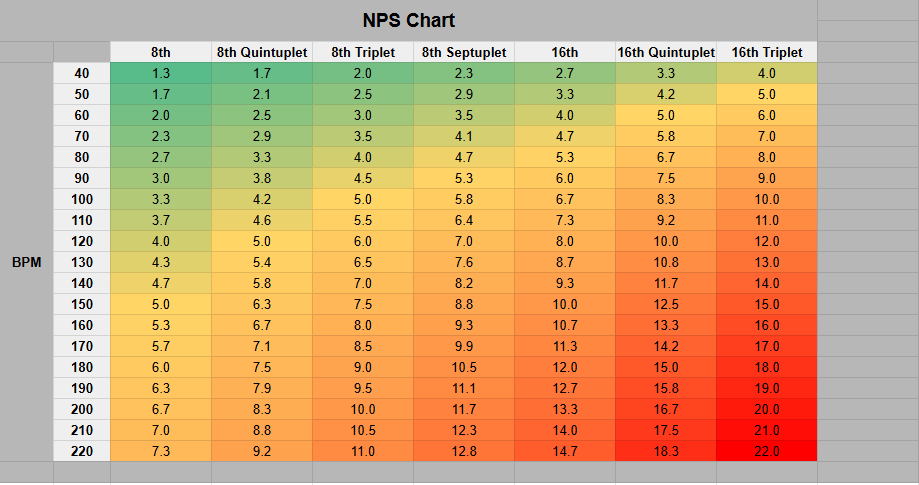
Learning Tool - NPS Chart

I know that metronomes aren’t all they are cracked up to be, but others may have run into the same issue I have, which is as follows:

As well as actual practice sessions, I also like to spend maybe 30 minutes jamming to backing tracks, mostly found on youtube. I want to be putting what speed I have into action in a musical sense, but I often find I have “BPM Deserts” where I avoid certain speeds because (using common subdivisions) it is either too slow to be fun, or too fast for me to play.

An example of this would be at 120bpm. It’s a nice, lively tempo for a track, but 8th notes are slow (4NPS), 16 notes are slow (8NPS), yet 16th note triplets (12NPS) are too fast. This leaves all tracks at 120 unsuitable for putting my speedy licks into action.

Going (slowly) through the synchronicity course reminded me of this chart I made a few years ago, showing the common subdivisions as well as some extra ones so that, in theory, and assuming that I practice chunking properly for 5s and 7s, I should be able to play some speedy licks at any tempo at a glance, without having to do maths.

Please let me know if this is of any use to you all :slight_smile:

N.B. There is much merit in playing without speedy licks, but that is obviously not the focus of this.

1 Like

I like it! Just printed it out.

I feel like something doesn’t make sense here though. Maybe I’m missing something but the order on the top seems weird.

8th note is two notes per click
8th note triplet is three
8th note quintiplet should be 5, no?

Do you mean quarter note quintiplet? That would be 5 notes per 2 clicks.

I think so anyway.

You could add quarter note triplets.

Maybe I’m wrong, either way, it’s a good idea.

I think what you want is
8th notes (4 beats per two clicks)
quarter note quintuplets (5 beats per two clicks)
8th note triplets (6 beats per two clicks)
quarter note septuplets (7 beats per two clicks)
16th notes (8 beats per two clicks)
8th note quintuplets (5 beats per click)
16th note triplets (6 beats per click)

It would be cool in greyscale to print out…

Thanks!

1 Like

Good question, and one I had to look up in order to get it right. They are in the order that they are in terms of how many notes per regular measure(in order, 2, 2.5, 3, 3.5, 4, 5, 6)

Triplets have a 3:2 ratio according to standard notation, so for 8th note triplets, you would get 3 notes in the place of 2 regular 8th notes. This translates to 3 notes per click.

For 16th note triplets, same ratio, you get 3 notes in place of 2 regular 16 notes, which translates to 6 notes per click.

Here’s where it got a bit confusing, the standard ratios for quintuplets and septuplets are not 5:2 and 7:2, they are in fact 5:4 and 7:4. Therefore they work out as follows:

For 8th note quintuplets, you get 5 notes instead of 4 regular 8th notes, which translates to 5 notes per 2 clicks (N.B this does not work out evenly as 2.5 notes per click)

For 8th note septuplets, you get 7 notes instead of 4 regular 8th notes, which translates to 7 notes per 2 clicks (N.B this does not work out evenly as 3.5 notes per click)

For 16th quintuplets, you get 5 notes instead of 4 regular 16th notes (1 click total), which translates to 5 notes per click.

Does that help?

1 Like

I think ‘nps’ is a good unit to estimate what the same picking speed corresponds to at different tempos.

So for example, if I remember correctly:

16ths at 165 = 5s at 132 = 6s at 110 = 11nps

However (apologies if I am stating the obvious) it’s good to keep in mind that nps alone doesn’t tell you how difficult a certain passage may be. 13nps tremolo on a single note is obviously a different skill compared to - say - doing a forward roll at 10nps.

1 Like

Absolutely right! This has nothing to do with how difficult a passage is, but I’ve got it as a tool to help identify certain things:

1: in “BPM Deserts”, what measures could I use within my current ability level to achieve something I would consider “fast”.
2. If I know that 113bpm 16 note triplets (11.3nps) is manageable for me, yet 16 notes at 170 (also 11.3nps) is challenging (assume same or similar lick), then something about how I am approaching the two different tempos (but identical speeds) is holding me back. It could be physical, it could be psychological.
3. To encourage me to practice quintuplets :stuck_out_tongue:

2 Likes

I am wrong. I hate that.

The tuplet thing was clarified, but just as an easy point to remember: no sort of eighth note can be faster than sixteenths, no sort of sixteenths can be faster than 32nds, and so forth. So eighth note quintuplets couldn’t be 5 notes per beat, as that exceeds 16th notes’ 4 - 5 notes per beat would 16th note quintuplets.

1 Like

I thought exactly the same as you did until I went to make the chart and googled the ratios, guess we are in the same boat really.

1 Like

I don’t want to talk about it :wink:

1 Like

Yes, or possibly Hz?

1 Like

Yes actually in the music world we are guilty of confusing speed with frequency… although NPS could be thought of as a generalised velocity I guess :laughing:

2 Likes

I’d at least briefly consider dying on the hill that we need to differentiate easily between cycles/second for sound waves, and cycles per second for our hands, ha, thus the numerator mattering. Maybe notes*hz would work lmao

1 Like

The thing about notes per second (nps) is that the score on whacking a barre chord might be off the charts: what is that, probably 60nps or more? Hz somehow suggests “turn around” (cycles) to me, but I agree about the confusion with vibrating strings, e.g., E2 = 82.41Hz, and so forth. I’m happy with either, though, and would vastly prefer nps or Hz over talk like “200 bpm sixteenth notes.”

1 Like

A while ago I found this page that does these calculations automatically for you. It’s awesome. I use it all the time to see how fast sextuplets need to be to correspond with 16ths at the same relative picking speed.

https://metricmodulationcalculator.com/subdivision/

I also use it to figure out smooth tempo changes when writing so that there is a basic pulse somewhere tying different tempos together.

1 Like

I mean it’s just factor 1.5 (for sextuplets), the site is nice but I’ve always just used a calculator for that :sweat_smile:

Well I’m awful at math so this kind of site is very helpful for me :stuck_out_tongue_winking_eye: