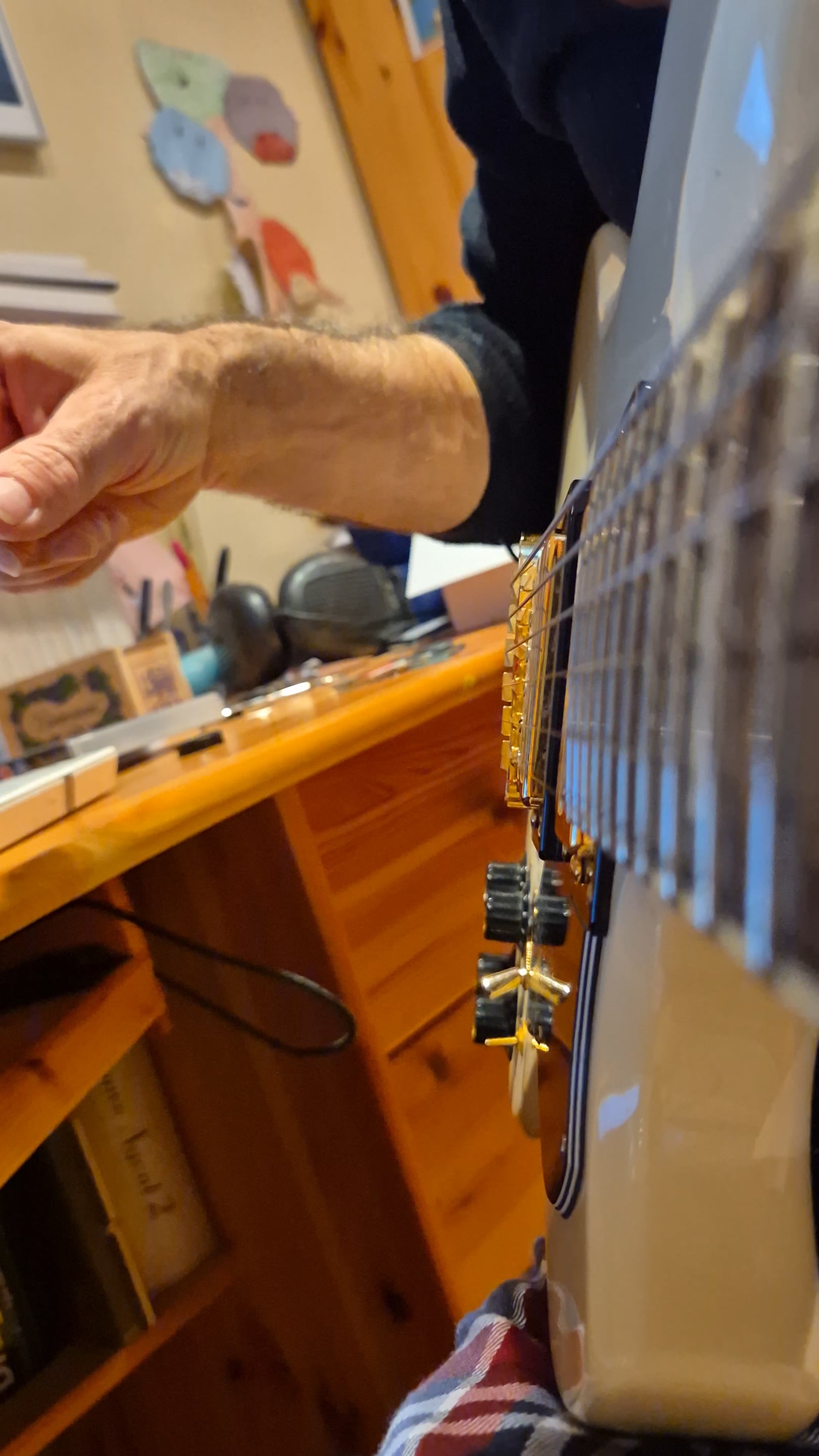
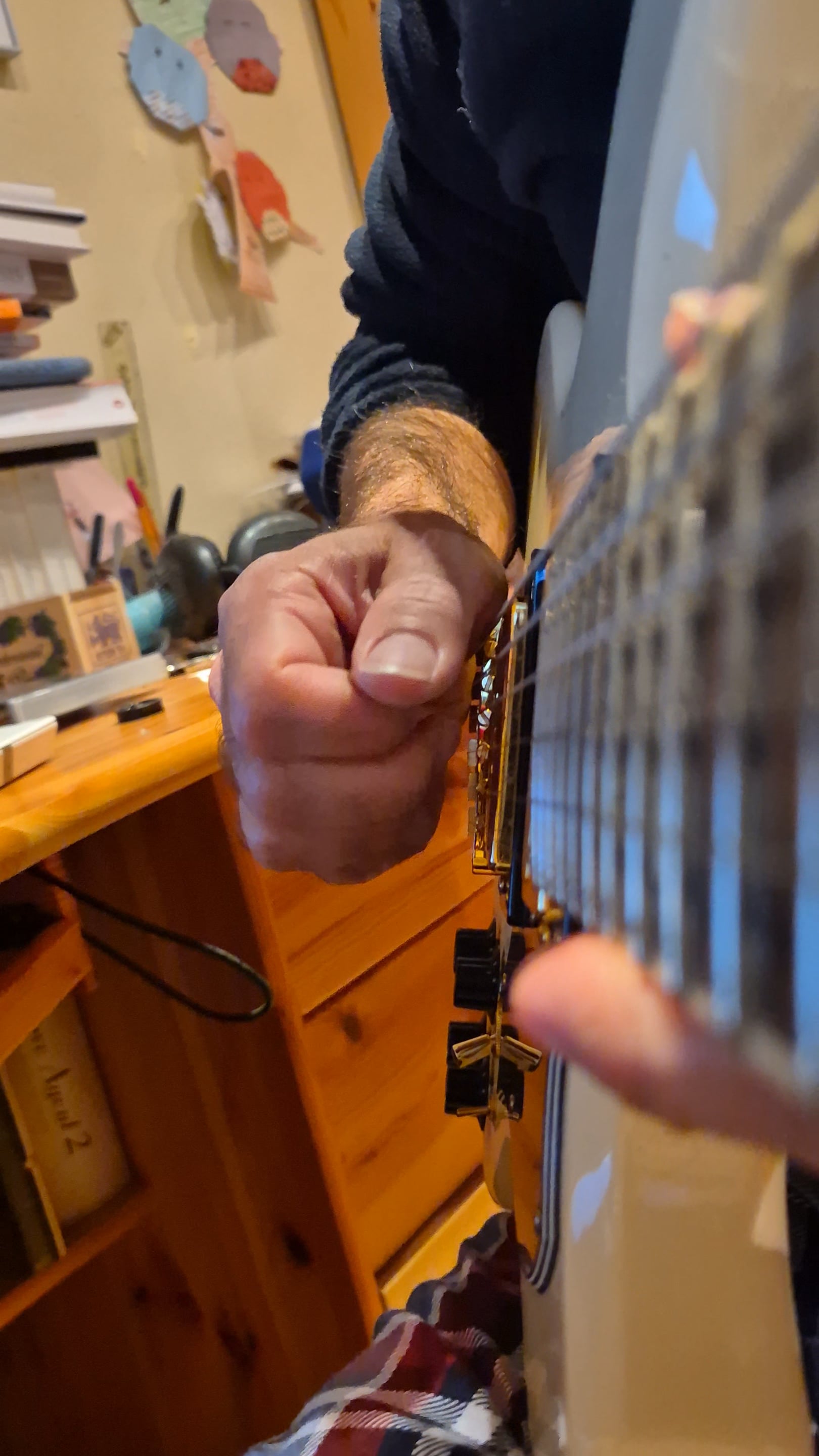
my name is Steffen, I turned 50 this year and I have been playing the guitar for more than 30 years. That is, I’ve been trying to. My left hand is quite ok, my right hand, well, is not. About two years ago I stumbled across Troy Grady and he certainly opened my eyes about a couple of things. But still I do not know what to do in order to improve my right hand. The just-do-what’s-natural-to-you-approach does not work with me, maybe because I don’t know (anymore) what is natural to me. Also, the idea of practising fast what you want to play fast obviously fails on me. Maybe it works for others. I need some structured way, but I haven’t found any. Actually I am really beginning to despair. I am really thinking about a drastic move. Like switching to flute or something.
Here there are two vid’s showing my incompetence. One was recorded at 100 bpm, the other one at 140 or so. At 100 bmp my hand seems to be bouncing this way and that way, it is as if my hand had a mind of itself. I guess there’s some rotation in there. At 140 the motion is quite straight, but it seems that the motion comes from the arm / elbow. At that speed I can play kind of regularly (kind of!) only on the high strings, but not on the D / D / lower E.
I also seem to have an odd habit (I haven’t recorded a video on that): when I try to alternate-pick even at quite low speeds like 16ths at 70 bpm, after doing the downstroke my hand automatically seems to bounce to the outside, like when you play downstrokes only. I don’t know why I am doing it but it is very hard to get rid of that habit.
If you have any ideas, let me know. Especially, if you know of any way of tackling the problems I am talking about in a clear and structured way.
Have you ever tried to just tremolo on one note as fast as you can and disregard cleanliness or evenness or even allow some tension just to see if you can do it?
I was also late to the game in developing my right hand from years of being beholden to the mentality of “start slow and build up” and never gave my nervous system the chance to feel what fast playing is supposed to feel like. I started playing death metal and since tremolo makes up so much of the rhythm playing in that genre, I had no choice but to just grit my teeth and go for it. It was sloppy and unmetered, but I learned to feel what it was to move my right hand fast.
Yes, I tried that. Doing tremoloes shows that the motion as such works, at least on the higher strings. But I cannot get it under control, especially not on the lower strings.
What worries me most is my inability to get a decent motion as mid-range tempos like 100 bpm (see the videos).
Watching the videos, I noticed that you’re only picking for 3 beats at a time or so. I don’t think that is really long enough to learn to get a feel of a good motion mechanic. What happens if you try to sustain for a full bar or two?
It also looks like you’re trying to move your wrist in a strict deviation path, and this has been shown here on CtC to not be as efficient as the RDT motion path for wrist picking. Have you seen Troy’s videos on RDT picking in the primer? He does go through a step by step method to learning it.
Also, it is important that you aren’t hyper controlling the motion. Motion accuracy and musical accuracy are two different things, and a lot of times in order to “control” musical accuracy during the motor learning phase, the motion accuracy can suffer. A picking motion that hasn’t been trained to synchronize with the left hand yet, or that occasionally clips through a rest stroke is still an accurate motion if it is following an escape path and feels easy to tremolo in the 165-170 bpm range, minimum.
There’s no difference whatsoever when I sustain it for a full bar or longer.
Maybe I misunderstand something, but is RDT not a specific way of ulnar / radial deviation?
I saw Troy’s videos on RDT picking. And actually I thought I followed them. The problem is that whenever I do that my hand / wrist / forearm automatically pronates quite clearly (I think one can see that at the 140 bpm video I posted). That is not a problem in itself, but for some reason the motion does not work on the lower strings.
Maybe I misunderstand something, but is RDT not a specific way of ulnar / radial deviation?
It’s not deviation at all, rather its a diagonal motion. In a general sense, its diagonal down to the thumb side and diagonal up to the pinky side.
Is this the video series you saw on RDT motion?
I know Troy has some free stuff on YouTube, but the really detailed tutorials are in the Primer.
It is also possible that your easiest motion is actually not even a wrist motion. Have you tried elbow or forearm based motions? Personally, I can’t do a pure RDT wrist motion, I do kind of like a Gypsy style forearm/wrist motion for my fastest speeds, and for like mid-tempo speeds in that 140 range I do a Joe Stump kind of finger/forearm motion.
I was hitting the same wall with my wrists motion for 20+ years until it finally clicked a couple weeks ago:
you probably think you are doing RDT but your motion looks too sideways from pinky to thumb. Instead, my mental reference is to pick in the direction of your knuckles. You can refine it as you go but the RDT trajectory is easier to establish by focusing moreon the inside-outside aspect of it rather than down-up deviation.
By simply angling your hand so that your knuckles are pointing in the direction you want the pick to move, just do it even if it looks too vertical at the beginning. I can assure you whatever level of deviation RDT needs is already including in the motion.
I’m still working on it but here’s one of my first attempts after I accidentally found the motion while working on a technique critique for elbow picking LOL (Viktor Frankl did again!):
Bear in mind this is one of the first times in my life that I’ve managed to pick with my wrist faster than 120bpm 16th notes. Now I am just refining it and working on synchronizing my hands but the motion and speed are coming along pretty well for my personal taste.
Another important consideration is that you can use the shape of the pick to guide your motion.
Thanks for sharing @steve506 . I accidentally find some wrist motion at times when practice elbow motion too. Cool to see there may be a possibility for exploring after I get the elbow synced
I am a firm believer in that, sometimes, the best way to find something is to do something else or nothing at all, like when you lose your car keys and the only way to find them is to stop looking for them.
Thanks for your reply!
I have tried elbow and forearm motions, they don’t really feel natural to me.
I do have access to the primer and I followed the RDT tutorial (and you are right, there is an element of deviation in the RDT motion, but it is not side-to-side). But when I try that motion what happens is this: Whereas I am supposed to lay the fleshy part of my right hand (where the pinky enters my hand, so to say) all along the bridge of the guitar, when playing the hand automatically and slowly extends a little and goes up in the air. So in the end, the hand is not anchored where the pisiform bone is, but rather where the scaphoid bone is, i.e. where the fleshy part close to the thumb is (I think one can see it in the 140 bpm video). I am not sure, but it seems this shows that a side-to-side-motion is more natural to me.
Problem A for me is that I can make this motion on the higher strings only, but not on the lower strings.
Problem B is that at moderate tempos like 100 bpm the motions falls apart completely - and I don’t know why.
Thanks a lot, I appreciate everybody trying to help me.
“Picking in the direction of the knuckles”, what exactly to you mean by that? To me this sounds like thinking in terms of flexion and extension only.
TLDR: imho, both RDT and strict flexion and extension feel virtually identical and if that’s not the case, you might not be doing RDT.
Oversimplifying for the sake of the example, If you knock on a table, the up and down motion is strict flexion and extension but if you rotate your forearm a little bit so your knocking motion goes more horizontal (similar to scribbling with a pen), the motion feels identical as the vertical knock but that’s RDT territory already and you don’t really need to add any deviation to it as it already has a sufficient amount to follow the trajectory you want.
From that point, it’s a matter of dialing in the pick grip and attack for a smooth flow across the string with a tone you like (I’m at this stage of the process).
I’m not sure what you mean but if you are referring to the rest strokes, that’s the point. The rest stroke against the next string is one of the most beneficial ways to obtain a physical feeling of how the motion is working.
If you look at the Primer and other CTC, many (most?) players rely on rest strokes to get immediate feedback on their pick attack that the nervous system seems to appreciate.
Besides that, I guess anything related to your grip and the orientation of the pick is a matter of taste as long as the motion is “right.”
Thanks for the contribution, even though it confuses me :-). See what Steve506 wrote: I think you mean what people call “rest strokes”? It seems to be quite normal for many. You think there’s a problem there?
The sideways pick like that can cause a tonal aspect that some people find unpleasant, and as such try to avoid - it makes the tone very “clicky” on rest strokes, in my opinion, and I avoid it.
Doesn’t mean it’s an invalid technique, especially when you add more stuff into the tonal chain to mask it.
As a recent convert to the importance of the rest stroke, do not dismiss it @EstebanE and @Ibanez1998 . There is a reason it is foundational to Troy’s pedagogy. The stronger feedback has started make a world of difference for me. Also worth noting that this forum, and this thread, are filled with some great players
Hey steve506. I wasn’t referring to rest strokes. I’m looking at the video and he’s spun the pick to a 90 degree angle. Very odd. so instead of the string hitting the flat side of the pick it’s hitting the rounded edge part, which some people including me do to some degree anyway, but this pick appears to be completely 90 degrees off the rotation it’s supposed to be essentially moving the pick sideways across the string. …the same edge of the pick Satriani uses for his fast pick tapping is what is hitting the string here. Very odd. I’m looking down the strings and seeing the face of the pick head on. I could read the logo if there was one. Additionally he’s choked up on that pic so far he’s never going to be able to pull off a pinch harmonic and my guess is it’s going to be difficult to control and the pick it going to be a level trying to pull out of his grasp.
Oh yeah I understand what you mean. Sure, the pick might be a little too vertical to your taste but that’s besides the point as I simply happened to come across RDT this way but there’s a lot of dialing in to do. However, the important thing is that the motion is there and anything else can be adjusted as you see fit.
Moreover, just to entertain the discussion, your analysis of the motion is only partially correct as the motion follows a diagonal. Think about it, if the motion were as head-on as you imagine it to be, there wouldn’t be a clear escape-to-trapped path.
Anyway, it was just a raw test to show OP that it is possible to go “from zero to somewhere” if you understand what your focus should be as I had never played with a primarily wrist-based motion in almost 30 years of playing. We can argue about the ins and outs of my technique on a different thread.