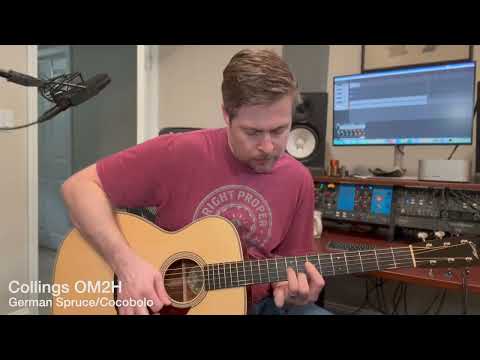
…and have been playing electric licks all over it ever since.
Video demo in lieu of pictures for now, though I’ll get some at some point I’m sure. Not my best playing, my fingertips were SHOT (played it most of the prior night and when you’re used to Elixirs, uncoated strings tear up your fingertips), but it’s just such an awesome sounding guitar - way more sustain on single notes than I think I’ve ever heard from an acoustic.
I did finally get some Elixirs on it last night and logged a couple hours after bedtime on picking exercises. Such an awesome guitar…
Thanks Tom, doubly so knowing what youy’re capable of with a guitar in your hands! The playing is only fair, though - a few timing hesitations (which are purely my own fault) and some notes not as cleanly fretted as they should be, which I’ll split the blame between not being used to uncoated strings and having absolutely raw fingertips, and the fact I haven’t been playing much acoustic the last few months. That’s changed in a BIG way since picking this guitar up, though.
Those are VERY different body designs. As it is, I’ve been used to what’s a 0000 body for, well, the last 25 years now, and kinda figured I’d end up with a dreadnaught of some sorts, but by the time I narrowed things down to two guitars, it was this or a custom shop 0000-28. Gorgeous guitar, too, and I could have fairly argued that even with the same body shape the rosewood body and a much more open high end (for whatever reason mine compresses in the high end pretty substantially when I strum harder; gorgeous for softer strumming) would have made it a different enough guitar that I could have justified owning both… but this one grabbed me from the first few notes, and I’d just asked about putting a deposit down and asking them to hold the pair of them for me for a week or so when I played one last ascending run and found myself thinking that’s exactly what I want an acoustic to sound like, so…
Yeah I guess it’s funny that I landed in a 0000 body shape when I was initially looking for an OM lol.
The bass and projection on that J-40 was just too appealing. Also I like the smaller waist compared to a dreadnought. I’m also very much a rosewood guy - if only Koa sounded like rosewood lol.
I mean, a Martin J is even bigger than a dreadnaught, while a 0000 is basically the “size” of a dreadnaught but more of a thinner 000/OM depth. I’ve never played a Martin J but they’re supposed to be huge. I have no doubt it projects like mad, though!
I haven’t played much acoustic guitar in the past few years, but I used to play a lot of fingerstyle. I’d even say it was my main focus for a while.
I started playing a bit more acoustic again recently. It really is a totally different thing from how I play electric guitar. Different fretting postures, different picking mechanics (even when flatpicking), different fretboard organisation, etc.
It brings out a different side of me, too. For whatever reason, I find composing music is much easier on an acoustic guitar. I should really do it more often.
Ok, this intrigues me. I’ve been trying to apply a lot of the same fretting hand lessons to the acoustic, primarily just being very aware of my wrist angle and trying to keep it as relaxed as possible… but if you have more extensive thoughts than that, I’d be very curious to hear them.
For me… I guess elements of my playing change. I still do a lot of similar lead stuff although I tend to pick a lot more since legato is a bit delicate on an acoustic, but I’ll also do a LOT of sustained strummed chordal stuff, moving notes around to create voicings and listening to them sustain and beat against themselves. I suppose some of this carries over to an electric, particularly on a Strat (where the attack is probably a little more acoustic-LIKE than my humbucker equipped guitars), but it definitely makes me play around with chordal stuff a lot more, and that’s a lot of fun.
Do you sing as well when playing? I’ve been working on singing while playing relatively difficult guitar parts for years and have gotten fairly proficient at it.
I much prefer singing over an acoustic for whatever reason. As soon as an electric solid body gets into my hands all that musicality goes right out the window.
There’s something about a terrific acoustic, it’s like a magical sound machine, physics seems to work over time and yet it’s effortless. I hope you get to try a Bluechip TAD-3R 60 pick with this guitar, match made in heaven.
Technique can only be optimized relative to constraints. We have performer constraints, environmental constraints, and task constraints. I’m still the same person, whether I play an electric or an acoustic guitar, and biomechanics are still biomechanics, so the performer constraints don’t change. However, an acoustic guitar is very different from an electric guitar (different environmental constraints), and the repertoire is also very different (different task constraints).
I use significantly heavier strings on an acoustic guitar. At the moment I’m using 11s for standard tuning and 12s for open tunings, but I used to use 12s and 13s. On my electric guitars, I use 9s or 9.5s. My action is significantly higher on my acoustic guitars, too.
The force requirements are much higher, so while I still base my fretting postures around my hand at rest, I position my hand to align naturally stronger gripping mechanics by default.
I don’t really play single-note leads on acoustics guitars. It’s almost all polyphonic and mostly finger picked, with some strumming and flat picked chordal parts. On acoustics, I fret mostly with the tips of my fingers, where I fret more with the pads on electric guitars. My damping is more selective and deliberate on an acoustic guitar. For electric lead playing, everything is damped by default in my positions of rest.
Then, there’s a difference in preferred register on the neck. My default fretting postures on an acoustic is biased for lower positions, say the open to about the 9th fret. I would rarely play higher than the 12th or 14th fret on an acoustic, and even then, only on the higher strings. On an electric guitar, my default fretting postures are informed more by the middle of the neck to allow for both low and higher positions.
I don’t really use the same mapping for the fretboard on acoustic and electric guitars either. On an electric guitar, I’m biased more towards movable shapes. Everything is relative, I have no preferred keys. For me, the acoustic is more absolute. I’m much more grounded in the CAGED keys, each key has it’s own unique character, and I use alternate tunings much more regularly. I use capos to transpose and I incorporate open strings into melodies much more.
I rarely bend on acoustics, and I have different preferences with vibrato. I do use hammer-ons and pull-offs in isolation, but I don’t do continuous legato often.
This isn’t to say that there’s no transfer between acoustic and electric playing (because there obviously is), but I think acoustic guitars and electric guitars are fundamentally different instruments. An acoustic guitar generates sound, an electric guitar generates signal.
Tom, you’re a goldmine of thoughtfulness and self-analysis, and I’m grateful to get to have these conversations with you
It’s doubly interesting because we really do have different considerations here, huh? I’m playing 12s and on an acousrtic I don’t like to go below that (and, specific to this OM, it has a fixed truss rod and Collings basically tells you to stick to 12s in the owner’s manual, lol). But, action here isn’t THAT mich higher than my electric (though with smaller frets the feel is different) and while the bass side is a bit higher than the treble, if over a full year action remains stable (super seasonal here in New England) I may bring it in and have them lower the bass side a hair. But in any event it’s actually not far from my electrics, which are low but not obscenely so.
And, I DO play a lot of single notes and a lot of bending. I think I do still tend to use more force than necessary on an electric, and definitely on an acoustic but part of that is simply because my calluses aren’t up to snuff here yet, and Im hoping as my fingers get stronger I can use a lighter-and-lighter “feeling” touch.
Your playing position and orientation of the neck relative to your body is way different of course, by virtue of a guitar sitting on your lap vs hanging off a strap.
It sounds like though that mechanically I’m probably not far off in thinking of technique optimization as broadly similar to an electric, and focusing on keeping my wrist feeling relaxed and my touch as loose as clean fretting allows, and there’s just going to be an adjustment period as both hands get used ot the heavier strings. But, that’s definitely something to monitor over time…
Yeah, I think so. My electrics and my acoustics are very different, and I do very different things with them. I don’t believe there’s a universal technique that would allow me to play anything on any guitar. If I were to try to find some compromise, it would likely give me inferior results in both areas.
I’m sure there’s some small element of strength, particularly for the smaller intrinsic muscles of the hand, but I think fretting heavier strings is more about aligning the stronger extrinsic muscles in the forearm to the task of fretting. The “arching” fretting posture that most acoustic virtuosos use better aligns the extrinsic flexors, which are much stronger.
There’s also a leverage effect, the arching posture effectively shortens the fingers, so there’s less leverage on the MCP joints. The postures that most electric virtuosos use effectively lengthen the fingers, so that with the same angle at the MCP joints, the end of the finger travels a greater distance more quickly.
Not often, honestly. I played that piece to death when I was a teenager.