
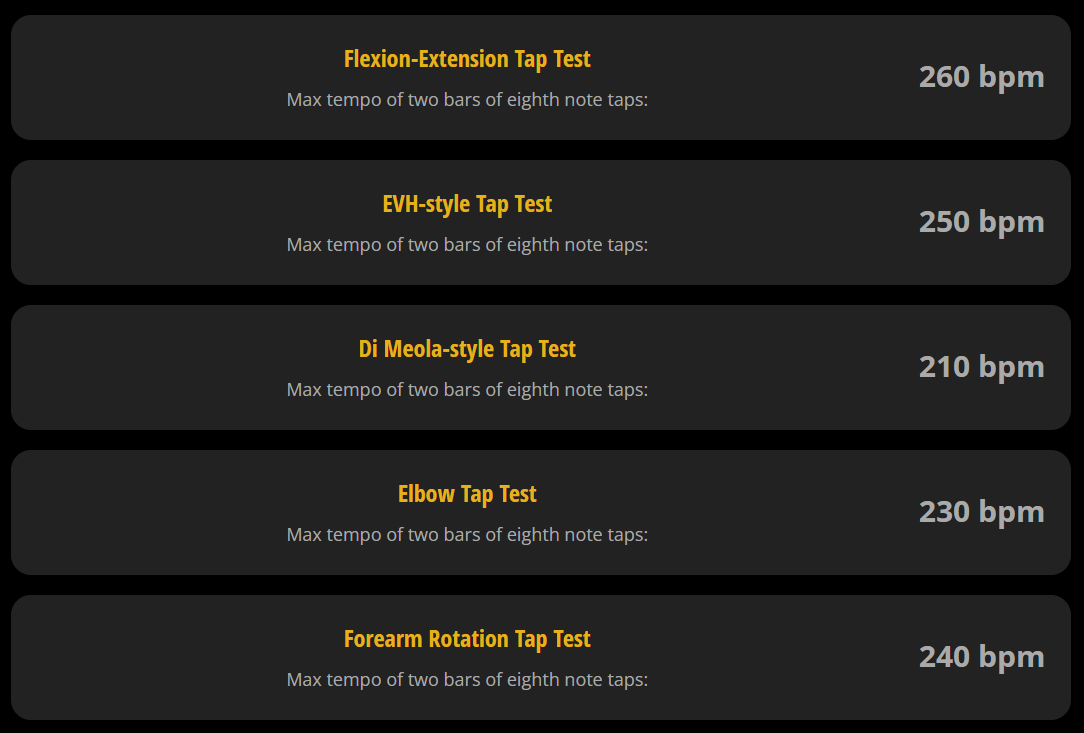
Are you talking about these ones, or something else? (My issues are fretting, not picking speed.)
1 Like
Sorry, this is a forum dedicated to picking so you can see how Tommo and I made that assumption. But have you done them? Even if it’s primarily a legato problem the hands do work together; if you have trouble with 150 bpm that could be an issue.
Yep, I have. Sorry I didn’t specify - those results I posted above are mine.
Those results are faster than mine and I can play 200 BPM+ lines, you should be fine. Upload some video though, trust me it’s best. You don’t have to post publicly but without video IMO you’ll be spinning your wheels.
If only my raw picking hand speed translated to my fretting hand, I’d be golden! (Those results are definitely misleading though - the table tap tests show I technically have good speed but I’ve only managed to figure out one motion that works reliably on a guitar - DSX - which ironically is the motion most associated with my lowest table tap test speeds!)
I uploaded videos a while back in this thread: Critique/advice on what feels like fine motor limitations I’m not concerned about posting publicly - heck, if you watch it, you’ll see that it’s practically a series of public humiliation takes  I also did a technique critique and while it was helpful in certain ways, I think the fretting/sync issues I’m experiencing are a bit outside the scope of this forum’s focus (as you mentioned, we’re mostly focused on picking here).
I’m currently working with Tom Gilroy and also trying my weird system so perhaps those will help.
1 Like
Hot damn! Those are fast! WOW! Good job, man!
Oh you think that’s fast? Wait 'til you see my 100bpm legato runs!
Why I gotta be born so lopsided? 
1 Like
Honestly it doesn’t matter until you decide what you want to play.
True, most people come here to discuss picking issues, because those are the main difficulties that 99% of players face.
However, our research and teaching is definitely expanding into all areas of guitar playing including (but not limited to) fretting motions and synchronization between the two hands 
I should also point out that one of the main concepts we teach and talk about, “chunking”, is very relevant to both the picking and fretting hand.
In this case Gumgo’s tapping tests were really fast, so even though that’s RH it likely rules out a lack of motor skills.
This is the first time in decades that I’ve actually practiced and the relationship between left and right hands fascinates me; at first my thought was “my left hand is fine, I’ll just work on the picking,” but here’s an interesting scenario: I could never play Yngwie sixes well, primarily because of the string change (I was using DSX so that was doomed in the past.)
My left hand was indeed ahead of the right so it seemed to make sense to just focus on picking. However, my left hand was not at 100%. So I focused on that and as the left hand got better, it freed up focus for the right hand.
Another great example is Randy Rhoads’ repeating pentatonic triplets from Mr. Crowley (at 2:25.) I could never do them that fast, but why? My left hand would lock up even though I could trill faster than that. Well, the string changes are brutal and stole the focus focus from what I thought I was working on.
I really like the tight focus of this forum on picking, but a side-focus on left hand with the same evidence-based approach would be most welcome!
Yeah, this is also a big challenge for me. Even for patterns that feel okay on each hand alone, putting them together unlocks another level of confusion. My brain can only think about one hand at a time, and I never really seem to be able to establish a level of muscle memory which doesn’t require some level of focus. For example, one thing that often throws me off is actually hammer one/pull offs in a run of otherwise alternate picked notes: despite being “easier” for the picking hand, it requires skipping a note and interrupting the alternate picking pattern, which shifts my focus to my picking hand, and suddenly fretting hand gets lost.
I agree it’s weirdly difficult to put one legato note in a picked phrase, when I realized some great players do that I was like “What?!”
I’m guessing but I suspect you’ve got muscles working against each other and if you can isolate them, cut them out of the equation, things will progress much faster.
I’m in an unusual circumstance, many years ago I just . . . stopped practicing. When you get to a certain level you can coast pretty much forever, I’d even stop playing at all sometimes for months or years and it would be back in a couple of weeks, or at least 80%.
Practicing again, with the CtC mentality, is quite something; I’m noticing things I never noticed before.
The other day I had a breakthrough and just went full-tilt, playing this lick as fast as I possibly could, just for fun. Next day my tricep, of all things, was killing me.
Tricep isn’t used for picking, I’d just been flexing it unconsciously; I’ll bet something like that is holding you back. Having said that I defer to Tom Gilroy on all matters legato!
1 Like
I’m guessing my issue is a combination of technique deficiency such as excess tension, inefficient use of opposing muscles, etc. (which I fully believe can be improved with proper practice) and a mental block of some sort which prevents me from efficiency encoding what I practice into consistently-recallable muscle memory. Perhaps some sort of mild learning disability? It’s hard to say. I’d love to believe that I’m just going about it all wrong, and I do my best to remain optimistic (though not always successfully) that both technique and proper approach to practice of said technique are learnable.
Troy has mentioned that his approach to practice has essentially been “keep trying and make little tweaks until you stumble onto something that works” (I apologize if I have interpreted his words wrong and I don’t mean to misrepresent him or anyone else). He has certainly managed to reach an extremely high level of skill and consistency. It sounds so simple but I haven’t managed to get very far with that approach (or any other really).
I really wonder what this form of practice looks like in, uh, practice. I’d love to see a video of somebody learning a hard lick or technique from scratch and I imagine that it would provide insight into (a) what I’m doing wrong (e.g. I’m chunking wrong or something) and (b) fundamental differences in motor learning ability (e.g. person X can repeat something 50 times and then it “clicks” whereas that does not happen for me). I posted a thread asking about this but it didn’t get much traction.
I can tell you it takes me about a week for some new gypsy jazz phrases to set in to the hands to start allowing me to flow with it in more of a finesse fashion. Then I can start really feeling the speed start building on it. I think we are all different, and some phrases will stick others won’t no matter how hard you try.
I should probably be a bit more specific to as I was reading further up, and yes there is a distinct path that happens when I learn a new lick as well. The picking hand is the one that gets the most focus day 1, day 2 or 3 is when the fretting hand gets the most attention, then it will start coming together with more of a subconsciousness happening with less focus on either hand.
You just have to make absolutely certain you are making the correct strokes and motions during the infancy of learning a new phrase.
This is why I try to push learning the rest stroke as it will help with getting a feel for the rhythmical command of the phrases, as well as when the picking needs to happen. Because during a pull off or a hammer on after a down stroke, you keep resting the pick until you are done legato’ing before doing an upstroke to escape the string or remain on the same string.
Whether one ends up using it or not it can be a great tool in your aresenal for learning new phrases. The initial newly resting the pick comprehension picking phase of a new lick clearly can bake in the picking motor mechanics for me lightyears better than any other techniques I was using in my past. The consistency is unreal, and it sort of freaks me out how well it works. In fact I was telling Scottulus that it can help me fake feel so well that I could fool anyone in believing I could play a solo pretty cleanly, accurately, but it wouldn’t be improvised. 
1 Like
Nah, I think you might be just being way too hard on yourself. Tension? Maybe. That was a big one for me (Still is!).
This is me, but some of the biggest leaps forward in my playing (LH and RH) have almost always been when I could take some very small - umm lets call it a “rudiment” or a “chunk” - and get very warm and fuzzy with it. You know, get so that one could assimilate and personalize the chunk and maybe make your own small bits of music out of that. A looper pedal is a really fantastic way to practice that, as is a daw. No it won’t sound like EVH, but hey maybe it’s OK to start out sounding a bit rough so you can find a thing you can do that jives!
Good luck, man! I wish I could help more!
2 Likes
Thanks once again for the detailed explanation! This really does help give me a sense of direction. So when you’re starting out with a new phrase, it sounds like you start slow enough to make sure each fret placement and pick stroke is correct, this being the “burn in the pattern” phase. Do you ever work on the picking and fretting hand separately?
What does this feel like for you, and how can you tell you’re ready to start speeding up?
I always try to fret something, I might take a same picking pattern into another scale/mode/arpeggio. When the first initial phase happens my brain tries to maintain highest priority on the picking hand. However of course you still have to fret. Often times I can mess this up, but I feel the more phrases you learn the more the left hand can kind of coast. Picking for me is the most complex so I put it at the highest priority. There will be times I flub up the fingerings, and then that is when I have to either rework it back up, or re engineer something better. That will likely happen day 2 or 3.
This happens when I no longer have to think about the individual rest strokes I am making, or the fingerings. Everything will start to feel as it is a subconscious feeling throughout the entire phrase since the faster you go there will be no time to critically analyze what you are doing.
This is also why you must play the entire phrase with some kind of rhythmical flow I think 50% speed is about slow enough that you can still hear what it is you are trying to convey. As you learn it and play it slow it must still convey the exact message so your brain can comprehend the tonal quality of it.
If you want I can show you over video chat sometime with a phrase that I don’t know. So you can see how the process works for me.
You know there could also be steps before these as well if you have to transcribe it. That could take you some time as well if you are trying to play it one for one. Or you may have to rework the lick into your own picking tendencies.
I’d be very interested to see your process and would be happy to pay a lesson fee for your time.
Completely disregard my comment above! I’m getting caught back up here on the site and on the Starting With Speed part of the testing motions section, I see the picture of Shawn Lane 
Hey everyone, I figured I’d post an update on my progress with these issues. Following the CtC approach, I decided to get very analytical and try to pinpoint precisely what has been causing me problems, then come up with ways to attempt to fix those root causes.
My starting point was the following: what is the most basic possible motion test for the fretting hand? Well, it’s essentially the table tapping test but tapping finger patterns with the fretting hand. I tried some tapping pattern tests and, unsurprisingly, did terrible. I could do okay with “descending” patterns 4-2-1 and 3-2-1 but all the others were just awful - super inconsistent timing and I’d randomly lose the pattern. For example, 1-2-3-1-2-3 would quickly degrade into 1–23–1–23. And anything more complex than straight ascending or descending I couldn’t even (and still generally can’t) maintain more than a few reps of above around 100bpm. For instance, if I try to tap 1-3-2-3 at around 120bpm, I can do about 3-4 reps and then my fingers get “confused” and the wrong one fires unexpectedly.
So the first thing I did was to try to get into the habit of constantly practicing tapping patterns on my arm, the table, or even just in the air to try to improve my brain’s ability to send rhythmic nerve pulses to my fingers (I think Claus Levin has a video recommending this). This actually has, so far, helped to improve “ascending” patterns (1-2-3, 1-2-4, 1-2-3-4) quite a bit. They still don’t feel as natural as the common “roll your fingers on the table” pattern (4-3-2-1) but they’re not quite so awkward now. I haven’t worked much on more complex patterns like 1-3-2-3 or Yngwie for example, but I suspect with “tapping practice” I could get those to improve, at least to a degree.
The piece that was still missing from this was the ability to get feedback on my progress. I could tap 1-2-3 better than before but playing it on guitar still had a bunch of muted notes/sync problems. So I wrote a simple program to capture and analyze computer keyboard keypress timing data (source code here in case you’re interested in trying it out - be warned that the code is pretty messy). It works by treating the keyboard keys as frets (e.g. x is a “lower fret” than z) and captures repeating sequences such as v-x-z-v-x-z-v-x-z. During each capture, it’ll show in realtime your BPM, relative duration of each “note”, and overall timing variance. It logs all captured data for later analysis. I tried to cover the basic “common” guitar situations - for instance, pressing v has no effect if z (a “higher fret”) is already pressed, and patterns like v-x-z-z expect you to just hold z for 2 beats instead of pressing it twice.
Obviously, this is not at all the same as a real guitar, but the idea is that since my career involves being behind a computer for 8+ hours a day, it wouldn’t hurt to periodically practice tapping patterns throughout the day. Some amount of timed nerve impulse training probably transfers to the guitar (and if not, all I wasted was some time).
So far my total training time is 3h40m (that’s the actual amount of time spent actively tapping patterns in the program). The pattern I have focused on most so far is 1-2-3 (v-x-z in “keyboard frets”) with a training time of 1h59m across 657 captures. Here’s a graph of recorded captures for that pattern:
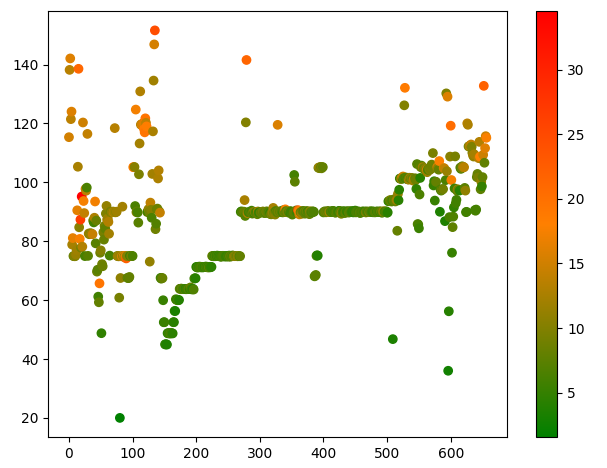
The x-axis is capture number, the y-axis is BPM (16th notes), and the color represents timing variance percentage, e.g. 20% means that the notes were, on average, 20% shorter or longer than the ideal note duration at the captured tempo (0% variance means that each note was perfectly on the beat). In this graph, you can see that I started out trying a bunch of various tempos. Then I “trained” for a while, working my way up from around 40bpm to 100bpm. During this time, I aimed to get < 5% timing variance before bumping up the tempo by a few BPM (though I appear to have accidentally skipped most of the 80-90 range). I got stuck at 90bpm for a long time. I eventually made it to around 100bpm and then tried some more randomized training.
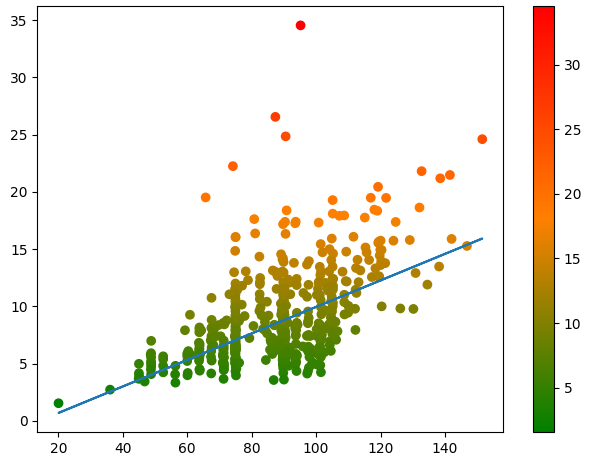
Here is a graph of BPM (x-axis) versus timing variance percent (y-axis):
If you instead graph BPM versus absolute timing variance (in milliseconds rather than percent of expected note duration), the trend line becomes flat around 15ms:
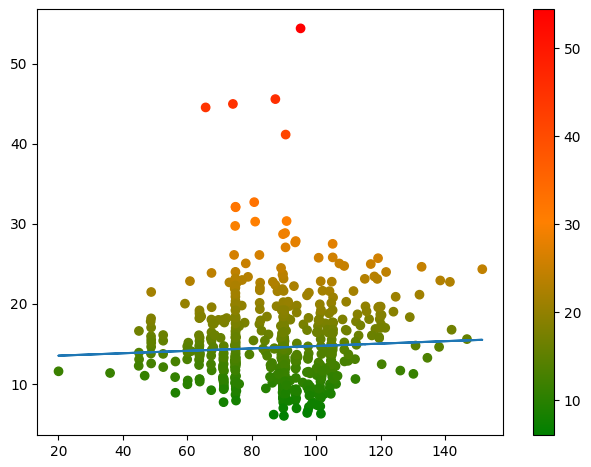
This means that there is a fixed 15ms of timing variation in my left hand playing of this pattern that does not seem to change with tempo. It’s less noticeable at low tempos (because the notes are longer) but at 100bpm 16th notes, one note lasts 150ms. 15ms is 10% of that which is starting to become significant.
Unfortunately, 100bpm always seems to be a sticking point for me, and this training felt similar, so I’m not confident that I’ll make good progress by continuing this approach. 100bpm seems to be the point where I stop being able to think about each finger movement individually and my motion blurs together such that I start to lose control and precision. Here is a capture of 1-2-3 at 90bpm (each line shows the individual durations of the last 3 played notes relative to their total duration):
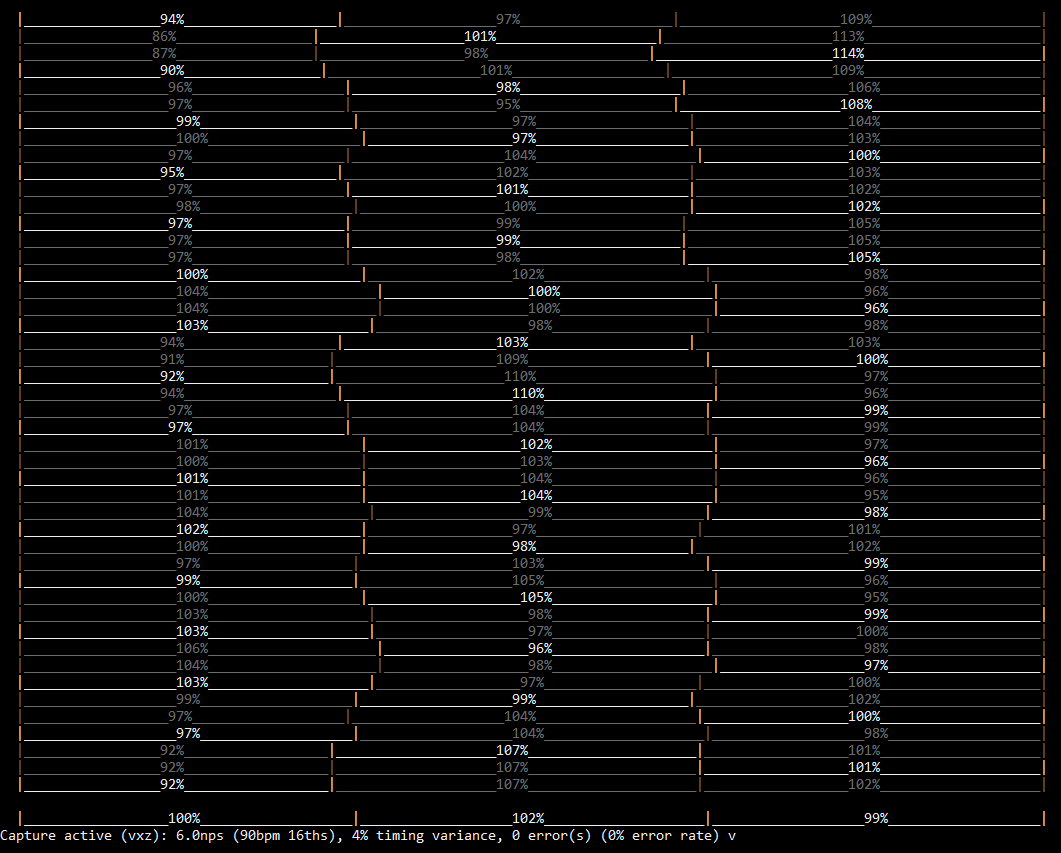
and here is a capture at 110bpm:
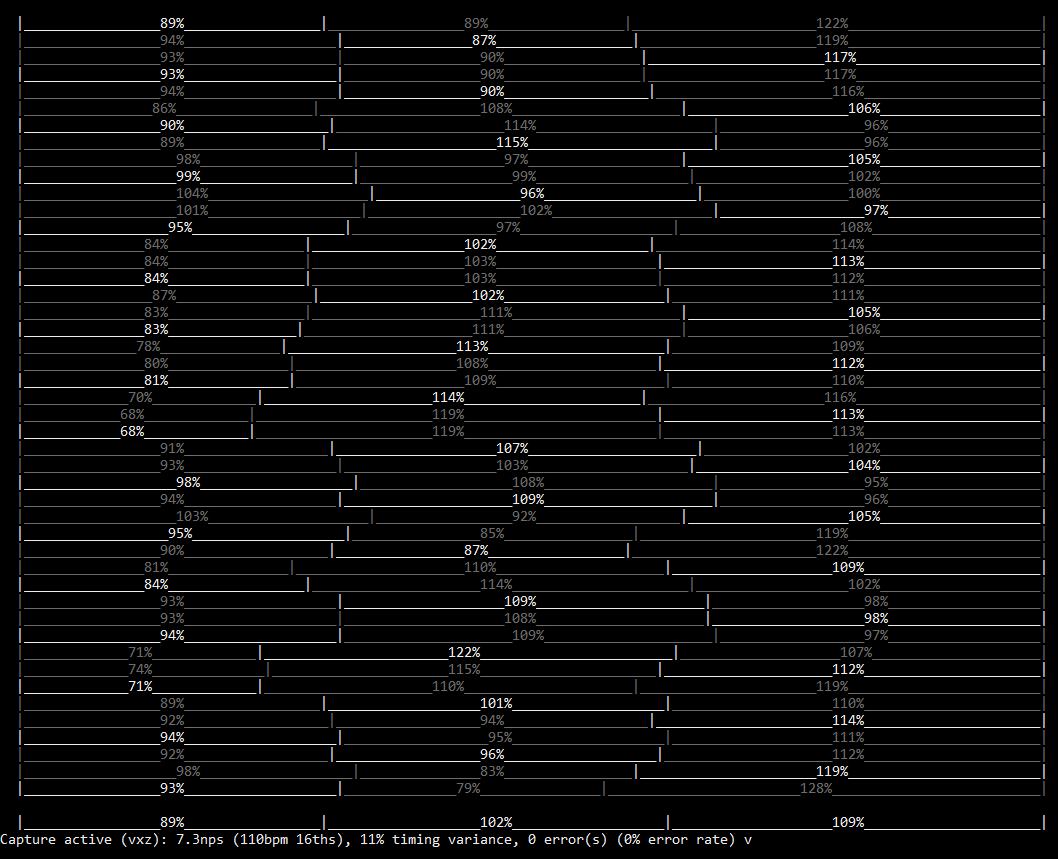
In the 90bpm capture you can see that the note durations are reasonably consistent and the overall timing variance is only 4%. The 110bpm capture is significantly worse. The notes timings bounce around a ton and the overall timing variance is up to 11%.
Aside from general messiness though, the 110bpm capture highlights a specific issue that I have: I’m consistently rolling onto finger 3 too soon (cutting off the note played by finger 2) and then not releasing finger 3 soon enough when transitioning back to finger 1. (In patterns such as 1-2-4, this same thing happens with finger 4.). On the guitar, I’ve always had issues with the first note of 1-2-3 (and 1-2-4) getting muted; same with the second note of 3-2-1 (and 4-2-1). These captures explicitly demonstrate the issue. The duration of the third note is consistently around 110-120% of what it should be. As I mentioned before, 100bpm is when this issue really starts to show up. At lower tempos, I can concentrate on making sure to place and lift finger 3 with accurate timing; above 100bpm, I lose the ability to think fast enough.
To attempt to address this, I worked on some even simpler patterns. 1-3-1-3 (v-z-v-z) I don’t have much trouble with - this is a pattern I can also play okay on guitar. 2-3-2-3 (x-z-x-z) exhibits the same issue as 1-2-3 though - finger 3 doesn’t release fast enough. So the usage of finger 2 is definitely contributing to the lagginess of finger 3 (some finger independence thing). If I hold down finger 2 the whole time (just raising and releasing 3) it’s not as bad, though still not perfect. I also tried working on patterns like 1-2-2-3 and 1-2-3-1-2-2 (where a repeated number means holding that note for twice the normal duration). I can get the timing better on these patterns as the pause gives me a moment to mentally reset and focus on the press/release action.
Of course, again, hitting keys on a keyboard isn’t the same as strings on a guitar. I’m also practicing legato and staccato. For legato, I’m going off of this Rick Graham video. I re-watch the video every few days, trying to mimic Rick’s posture and hand placement. My goal is to play scales with the absolute minimum amount of tension necessary. I’m playing very slowly (60-80bpm quarter notes) and even so, accurately muting strings and doing hammers-from-nowhere is quite a challenge. And even at that slow tempo, I often screw up the transition from finger 3 or 4 to finger 1 on the next string and end up getting no sound because 3 or 4 lifted too slowly.
The goal of staccato practice is to train myself to be able to lift my fingers more quickly. Like legato practice, I’m playing very slow scales (60-80bpm quarter notes) but this time each note is the absolute shortest little blip I can possibly make - no picking, just hammer-from-nowhere and release as quickly as possible. Once again, my focus is absolute minimum tension/force/effort. Initially, this was actually fairly mentally exhausting and I found it quite difficult to fret my fingers directly on the beat (even at 60bpm). It has gotten easier though. After doing this for 10-15 minutes, my fretting does feel noticeably lighter than usual when playing patterns like 1-2-3 or 1-2-4, so that’s a good sign.
Has any of this actually helped? Perhaps a bit, though hard to say. The touch of my fretting hand does feel lighter and perhaps a bit more agile (as long as I don’t forget and revert back). I think the basic patterns (1-2-3, etc.) have become a little easier. They are still not perfect, but I’m noticing the “ring/pinky finger lifts too slow” issue a bit less than I was before, and the hand sync feels perhaps a tiny bit more stable. I can sort of stumble my way through the Pop Tart lick once every 3-5 attempts. Here’s a short clip of how it’s sounding:
It still very much feels like there is some underlying issue that I haven’t been able to touch though, and I’m just doing my best to work around it. For one thing, there is pretty much absolutely nothing I can play consistently/confidently - yes, I quite literally mean nothing. Even something as simple as an open chord progression, shit you learn on day 1, I’ll screw up 5-10% of the time somehow. It’s like my hands are just not aligned to the same clock and it throws everything off (I haven’t even discussed my poor fretting hand accuracy).
Beyond just grinding out exercises, I’ve been trying to focus on writing music, which is ultimately my goal and which I find quite enjoyable. The challenge there, of course, is that I have to be able to play the stuff I write in order to record it. So on the more musical front, that has been my goal lately - learning to play the licks I want to record in my own songs. Nothing I’m writing is crazy fast or long runs - 8-20 notes no faster than 120bpm. What I’ve found is that I can sort of get the fretting patterns under my fingers, it just takes a comically long time. For example, with this simple DSX lick:
 d  u  d  u     d  u
------------------------------
-8--------8-h10----8-h10-b12--
----7--9--------9-------------
------------------------------
------------------------------
------------------------------
This. Should. Not. Be. Hard. Goddammit. And yet, the fretting hand was initially a disaster, so I spent a few practice sessions playing it slowly as all hammers (no right hand). I went snowboarding and spent the entire day repeatedly tapping the pattern (2-1-3-1-3-2-1-3) inside of my glove incessantly. It finally eventually started to click. Now, at this point, I can play the fretting and picking patterns okay, both isolated. But when I try to put them together, disaster strikes and I can get it cleanly maybe 1/5 attempts. I can play it fine up to… can you guess? 100bpm. It’s like a complete inability for my brain to multitask. Which is weird, because I used to play drums, which involves 4 limbs operating independently, and while I wasn’t particularly advanced, I don’t think I was THIS bad. With this, even the act of tapping my foot or bobbing my head to the beat will throw my fretting hand off (and that’s what everyone says is supposed to help!).
So as far as recording goes, it may end up being the case that I just need to record 100 short takes and splice them together. Which really bums me out, but at least it’s an option with modern technology.
The path forward is still not clear to me. Obviously I will continue to try to plink away at licks and exercises as it seems that does help a little bit. As another data point: in a lesson with Tom Gilroy we discussed how to cleanly bend strings and he showed me the way he approached it - how to catch the adjacent string just right so that it doesn’t ring out. I went and started practicing this for 10-15 minutes a day. Initially, it was extremely difficult and I could only get it to work maybe 15% of the time. But after a few days, it suddenly became much easier; not 100% consistency but perhaps around 75%. Something “clicked”, as it is supposed to with motor learning, so I feel that this, and the fact that I was able to learn that fretting hand lick pattern in isolation, does prove that I have some degree of motor learning ability. But despite tons and tons of practice, the hand timing/sync/coordination stuff has not clicked. If this is indeed a motor learning problem that can be solved via training, I don’t seem to be targeting the correct… system, I guess? From Wikipedia (sourcing this article, which I don’t have access to):
There are several areas of the brain that are found to contribute to temporal coordination of the limbs needed for bimanual tasks, and these areas include the premotor cortex (PMC), the parietal cortex, the mesial motor cortices, more specifically the supplementary motor area (SMA), the cingulate motor cortex (CMC), the primary motor cortex (M1), and the cerebellum.
I know little to nothing about any of those brain regions but I will have to do some research to see if there might be a way to narrow down where my issues might originate from and how to more effectively target the underdeveloped region.
This article is also interesting, which investigates the role of dopamine in coordination and motor control functions:
PD patients also experience significant disability from impaired manual dexterity, which causes difficulty with tasks like tying shoelaces, fastening buttons, and handwriting (Pohar and Allyson Jones, 2009). This symptom is distinct from bradykinesia (Foki et al., 2016), but also responds to dopamine replacement (Gebhardt et al., 2008; Lee et al., 2018). Thus, dopamine plays an important, but poorly defined, role in dexterous skill beyond simply regulating movement speed or amplitude.
And this one which discusses the connection between fine motor deficits and ADHD (which is related to dysfunctional dopamine pathways):
Motor problems are not usually part of assessments for ADHD and are not included in intervention programmes despite the estimate that 30% – 50% of children with ADHD exhibit motor problems.
I’ve never been diagnosed with ADHD but I’ve always wondered if I have some mild form of it, and if so, maybe this could be related.
But who knows. I honestly doubt we know enough about the brain for me to be able to make any progress with this approach, but it might at least be worth investigating.
Anyway, that’s where I’m at now; maybe a tiny bit of progress here and there, trying to stay positive, but still hitting major roadblocks.
1 Like