Solfege is really helping me but i have questions

@WhammyStarScream , yeah, what @joebegly said; one syllable for all 12 tones

sharps do (di) re (ri) mi fa (fi) so (si) la (li) ti

flats the “e” is actually an “ay” sound, eg, me is said as “may”:

do (ra) re (me) mi fa (se) so (le) la (te) ti do

I’m sure somebody has solfege syllables for double sharp and double flat but even my own OCD nerdery might stop before that point.

Yeah it’s powerful stuff…it’s one of the trickiest things to talk about I think because the benefits are long term and the processes can seem so goofy…like “why am I memorizing and singing these simple melodies with these weird syllables when I could be practicing some hot licks?”

1 Like

Or you could practice your hot licks using solfege too! Really bury those licks deep into your being. If my roommates thought I was annoying them with guitar pfft i can sing my licks wherever now! :smiley:

The long term thing is what I’ve encountered, it seems like trying to grab at something in the dark. And it seems intangible. But I know with constant practice for long periods of time it does build into a subconscious feeling. I find that with scale playing, sometimes I just know where the next note I want is by feeling, from excessive practice. Though even that can be flailing your arms in the dark at times.

Yes I think that’s one part of it, for sure!

Honestly I feel that if it is beyond anything monophonic then some aspect of relative pitch will be used to identify the notes. Whether that be memory, or the sound itself, in my mind it would be impossible to not hear the polyphony. So this is where I am leaning on the fence if its more of some super memory, or a subconscious memory, than it is an ear hearing thing in regards to absolute pitch.

Wouldnt you need some form of fixed do though for songs with multiple key changes? Regardless if its movable from the beginning, I mean when you modulate wouldnt you then need to use fixed do from the beginning movable do?

@bradejensen for me, I just change the syllables to be in the new key.

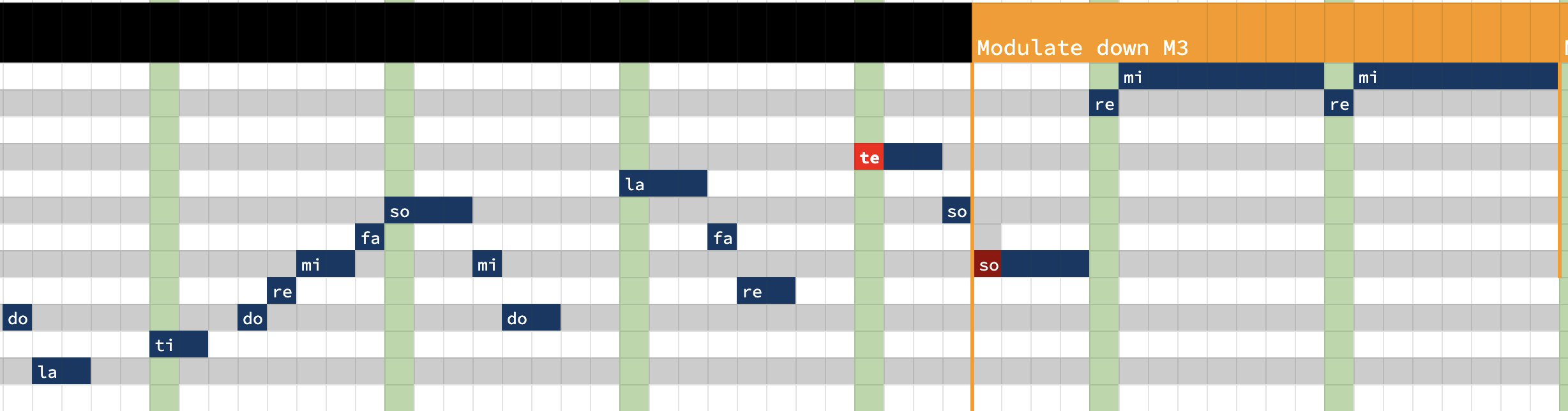
I was recently analyzing “somewhere” from west side story and trying to come up with a visual to show what I had in my head. here’s part of it:

jumping from that, into a key change:

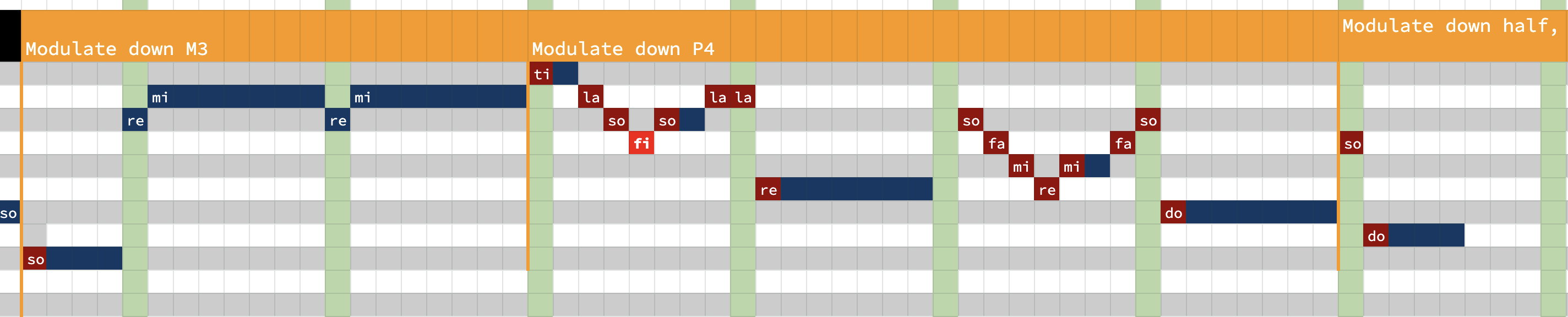
I just have to be aware that the “so” past the orange line is “so” for the new key, but it’s “me” in the old key.

Moving to the next part of the tune:

There might be some method for modulations that I’m not aware of, but here’s what’s important:
IF we’re clearly in a new key, the root of that key will sound as “do”, the third of that key as “mi”, etc, so it’s important to use the right solfege for that key, otherwise what we’re singing just won’t feel right.

where fixed do is useful, imo is when there really is no key center or tonal hierarchy at all (which technically isn’t really possible, but it’s a matter of degrees and what we’re used to hearing) and we want a pure representation of pitches independent of the concept of tonal center. That is not the type of concept or music that has ever been interesting to me so it’s not something I’ve dug into much; 99.999999999999999% of the music that people actually listen to or play has clear key centers even if they shift quickly.

I will have to disagree if your ear has been tuned in one key shifting into another doesnt mean another scale degree will sound like Do in that very moment. But once your ear tunes, yes it will sound like Do, but there is going to be a switching period.

Maybe this is why like in Back to the Future he is like watch me for the changes and try and keep up?

Sure, but the fact is that “mi” will sound different in many contexts even without a key change, so we do what we can.

A good example is Beatles “Something.”
Verse is in C, chorus modulates to A. For the lyric “you’re asking me will my love grow” the vocal melody starts on C# (third of A.) by the time the singing starts, I think we hear that pretty bluntly as “mi”

I am not entirely sure that you actually disagree with @JakeEstner here. The musical phenomenon you describe, is sometimes called „elision“ in music theory, and many composers make deliberate use of this to create smooth sounding modulations.
Agreed, the point where you start with the new key and stop with the old can seem a bit arbitrary if you feel the change differently, especially in more contemporary music, where there isn’t always a cadence or even a dominant (V chord) to cement the new key.
But all that @JakeEstner does is pick a point where the change to a new „Do“ makes sense. After all, you can’t sing two syllables at once.
I also think, that there should always be some hindsight involved when putting useful syllables to a musical line. These syllables themselves can carry additional musical information if used correctly, like recurring patterns, imitations, etc.
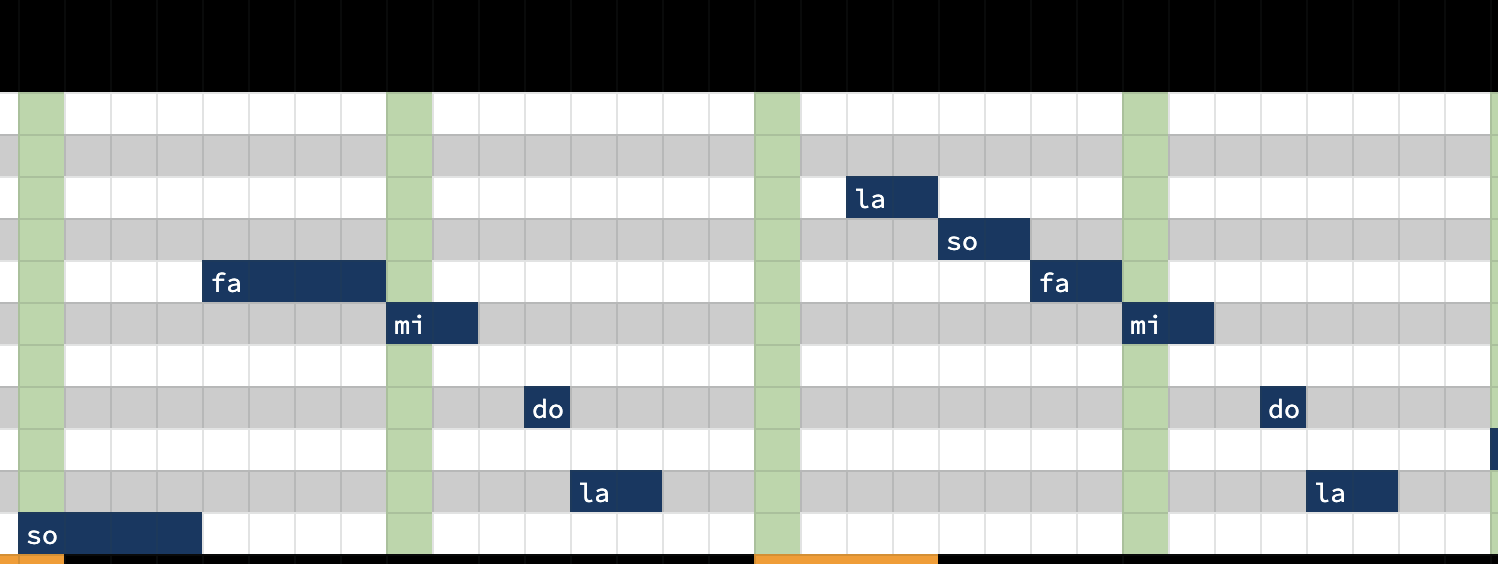
An interesting challenge I could think of regarding this is „black hole sun“ by soundgarden. What is the „Do“ there, and where do you change it?

Blackhole Sun is just in A throughout, tuned down 1/2 step so concert Ab. No modulations to my ears, just lots of mixing between modes and some other devices used.

Another nice thing about movable do solfege is that even with modal changes we’re covered…

verse
mi so la, mi so la
In my eyes, indisposed

mi so la, do so, la mi
In disguises no one knows

do re me…fa me re…
Hides the face, lies the snake

do so so mi mi re fa
In the sun, in my disgrace

(chorus)
do re me, fa me re,
Black hole sun, Won’t you come

do mi re re do fa
And wash away the rain

This looks like some sort of sequencer but you have used solfege. What program is this that you are using for solfege transcription? Its a cool way of going about it.

Lol I am almost certain there is no program involved. I used to do this with random songs all the time. It is a great ear training exercise and more importantly, it has real world application. It allows you to totally transcribe anything by ear. Yes, the key may be wrong if you don’t have perfect pitch. But relatively the notes will be correct. IMO that will go much further in all around musicianship development than chasing perfect pitch.

I hope you’ll allow a constructive criticism @bradejensen that a lot of the things you post are these very abstract “challenges” or music theory brain teasers. If you enjoy them and think they are helpful, definitely keep doing them and ignore my suggestion :wink: My stance is with only 24 hours in a day, I have to be really choosy about what I spend my time on. Finding something with direct application to a real world scenario is always what I aim for.

1 Like

hehe i know its just something fun to break the mold. i still practice my songs and improvising. sometimes i got to have a refresher behind the instrument, and take a break from grinding in certain zones. i also try to find theory stuff that might seem useful like ta ka gi na tom, all the other ones suck imo. but for some reason this one works for me, or it has helped me get a handle on 5s rhythm. i think it has to do with all the syllables are kinda unique.

definitely if this doesnt work for you don’t do it. it just helped me so i am sharing it in case it helps someone else.

The graphic? It’s google sheets. And thanks - I was trying to make a display that would show the notation a bit like piano roll.

I think he meant the graphic a few posts back, rather than the ability to decipher the notes

Ah thanks for that. I normally use the forum on my laptop and you can see more context in a reply to a post. That never seems to work on my phone and that is what I used today.

Right, that is all cool. I was just a little worried that for some of this stuff you may be going down a rabbit hole, getting so into various concepts that the end results of these things gets lost. If you have a good handle on it and you have a steady diet of the other hands on stuff (and most importantly) are enjoying yourself, by all means, continue :slight_smile:

So maybe I should opt for the blue pill? :sweat_smile:

1 Like

Its not my intent to step on toes, but I do disagree still. I feel that this retuning period of solfege to a new Do is just prohibiting absolute hearing. If we know that something has changed, and we are moving to a new anchor point, this feels like absolute pitch, but we are just neglecting to further our language acquisition by only learning Do instead of cementing it. When it seems easier to just shift things, since if we just change the key of a major scale we perceive it to be the same just higher or lower depending on which way you go sort of a curse of the way guitar has a kind of “relative” fingering as opposed to piano where if you switch to a another major key the finger changes quite drastically, a more “absolute” fingering. But it changed key, and since we shift utilizing a movable do approach we hear it as some sort of ascend or descend. That’s not wrong per say, but if we shift Do onto a new platform we are sidestepping something else entirely, hiding it away.

But this specific system really wasnt intended for fixed, it was first used as a movable system. Only later had that changed. But it does help to discover this other side of hearing things.

i think in order to kind of understand it you need to sing the solfege in different keys with fixed do in mind. Like Do Re Mi Fa So La Ti Do Ti La So Fa Mi Re Do Mi So Do So La Ti Do Re Mi Do Mi So Fi So Fi Mi Re Do Ti La So

And also I could be swapping in F# as Do because in the Key of F# or Gb major there is no C aka Do. Which is why I am thinking in my mind this has to be Do simply because Do is gone from this key. And if you look at all the other 5 scales with out C F# is in them. It is like the polar opposite of C natural after all it is the tritone of C.

I have this vision of taking this tonesavvy style game, but instead of piano use guitar distortion notes. lol

Absolute pitch and relative pitch are different set of challenges with different applications.

If you come across a way with solfege to indicate specific shifts in key center, I’d be interested, though as some unsolicited advice since you’re relatively new to the whole thing, I’d recommend not worrying too much about modulations for your own personal study, just yet!

If you prefer to use absolute pitch/fixed do for anything that has any modulations then there are benefits to that, but imo you lose pretty much the whole point/glory of movable do.

Also whether something is a true modulation or just temporary borrowing or something plays a big role as well.

But again, this is all talking about hypothetical stuff with more advanced material - something worth revisiting once you get very comfortable with movable do for scales, modes, patterns, etc.