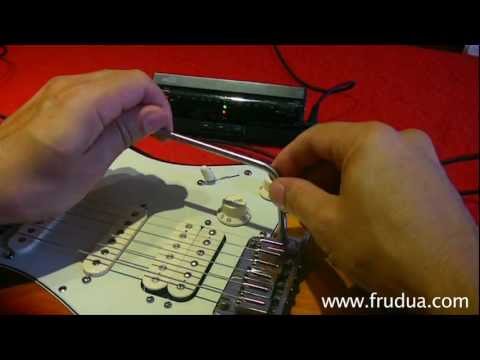
Staying in tune with a whammy bar

This is maybe a doubly stupid question because I’ve played guitar forever and I’m also a luthier, but mostly acoustic and mostly jazz. I’ve never really played with a whammy bar.

I built a guitar a couple years ago I call a “super stang”, it’s a mustang sized and scaled guitar but I put in a JB/Jazz set of SD pickups and a Wilkinson tremolo. I haven’t played the guitar all that much but lately I’ve been using it a lot and I’m getting sounds I’m really enjoying with it.

I’m a big Jeff Beck fan and lately I’ve been leaving the bar attached at all times just to see if I would use it more. It’s been fun trying to figure out settings where it would work for me.

Anyway, long story short, it definitely seems to knock the guitar out of tune. I have a bone nut on the guitar. I’m not sure what my expectation should be, if I totally dive bomb the bar as low as it will go while playing a chord, should I expect it should come back in tune? It doesn’t do that necessarily. Could I optomize the nut or does a locking nut really become necessary to have stability?

I know this is a huge kettle of fish but I would love some basic advice. I don’t think a locking nut would fit on this guitar.


Maybe it’s better than I thought. When I tuned it up after this the E string was sharp and the G string was flat. Maybe I could maximize the nut a bit. It definitely doesn’t stay perfectly in tune, but maybe this is pretty good without a locking nut?

Gets kinda stinky about halfway through. I feel like it has been worse than that sometimes but I never really tested it all that much.

It’s odd it seems to go out fairly randomly, it does maybe feel like a nut/tension equalization thing. I can do a lot of fucking with it and then once in a while it will go totally out but maybe it comes back most of the way.

I am not great about graphiting the nut slots but maybe I will now.

This is a pulling up test which seems to be somewhat worse than going down. I get that this isn’t really normal playing style, just seeing what it can do.

Hi @Sully75. I’m also a huge Jeff Beck fan, I float my non-locking vibrato bridges and I have no issues with tuning stability.

If the nut slots are cut too tight, the strings will bind there and there will always be problems with return to pitch. The nut slots need to be cut to allow the strings to move.

You want to ensure that you take the time to string the guitar correctly. We want to minimise the amount of string on the tuner. The more string wraps the tuner, the more potential for slipping. You want one wrap over the string end and one wrap under, so that the two wraps pinch the string end and lock it in place. Locking tuners are not necessary, but they are a major quality of life upgrade and they make string changes much quicker.

Strings need to be stretched along their length when stringing.

String trees create binding points. If a string tree can be removed, it should be. If not, the string tree should be as high as possible to minimise the break angle over the nut. The usual bent plate type is probably the worst performer and the vintage “button” style is quite poor, too. A roller design works much better. If you decide to install locking tuners, I’d recommend staggered tuners, these can help to eliminate a string tree or allow for a string tree to be set higher.

The bridge must actually float, meaning that no part of the plate can be in contact with the body in the neutral position. There needs to be some range of pull-up. Dive only will never return to neutral.

On a two-post vibrato this is easy. On a six-screw vibrato, you use the two outermost screws to set the height so that the plate can lift up from the body slightly. The other four screws should be set a little higher, so as not to interfere with the pivot on the two outer screws.

The points of contact at the nut and at any string trees should be lubricated every string change. I use silicone lubricant for RC models.

https://www.racing-cars.com/silicone-diff-lube-pot-u1301

It’s cheaper and better than the stuff that’s marketed for guitarists. You also want to use this lubricant wherever metal contacts metal in the bridge assembly, Between the plate and the posts or screws, where the springs sit on the claw, etc.

1 Like

+1 on locking tuners. They don’t fix tuning stability per se but are quite convenient and simplify a lot of variables. However, I’d suggest going for an “all short posts” set because the staggered ones might not give you enough break angle on the taller side. Also, string retainers on the headstock play a part here.

My suggestion: just get a brass nut and follow this video: