
Trapped primary motion

Question for anyone that might have the same issue: I have a trapped primary motion. All of my tests are reasonably fast (220-ish), and I can usually play a rhythmically steady tremolo at 190-ish, up to 210bpm on a good day. My motion however is a direct back and forth across the string, which leaves me fully trapped and unable to execute string crossing. I’m currently working with Joao to try and fix it, but it seems harder to ‘reprogram’ rather than learn a new skill. I’ve gone through the primer and saw the section about swiping addressing trapped motion, which seems like a rarely used solution.

Has anyone had a similar experience? If so, how did you fix it? Thanks for any advice!
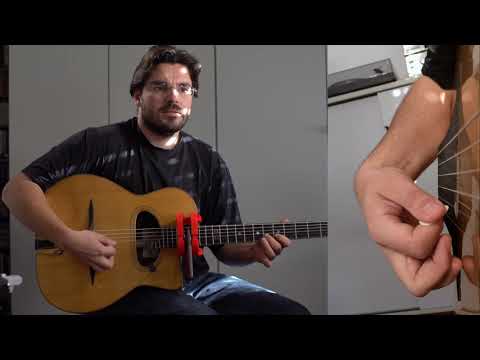
@joebegly had pointed out in the past that I probably have a fully trapped motion. If that’s the case, I would guess that I just use helper motions for all string changes (combo of some hopping / finger movement / arm movement). I’m sure I have swiped in the past, but I “try” not to.

I’ve personally just ramped up circular lines as much as possible and see what my hand does. What have you attempted so far?

Thanks for the reply. I’ve been working on transitioning to a USX or DSX movement (both motion tests were good), but the moment the tempo picks up above 150-ish, the motion reverts to being trapped. I’ve been filming with a magnet and trying to correct, and have focussed on appropriate pick slanting and grip. Everything is ok at a slowish tempo, but the moment speed picks up everything goes back to trapped. It’s been very frustrating. I’m a classically trained guitarist and I’ve been playing jazz for years, so it’s not a ‘beginner’ issue (which might actually be the problem–old, ingrained bad habits). I usually play fingerstyle and I’ve been interested in improving my pick skills, but not having much success. Joao’s advice has been great, but I’m unable to get it to work at tempo. I understand Troy’s comments about needing to practice at speed rather than slowly, but the moment things speed up the motion reverts to one that ‘works’ for me–trapped and swiping. I’ve literally been working on this for several hours a day. Feeling stuck and not sure where to go from here…

1 Like

Just my two cents:

“Hours a day” may be your problem. The timescale separation is weird: my experience is that it takes days or weeks to completely retool a technique, and playing more hours per session doesn’t really help.

1 Like

Hi Eric, thanks for that. I’ll definitely try switching to brief technique sessions with other repertoire in between–and be more patient. Several years ago I had to learn new flamenco techniques to accompany a dance class and they came quite quickly using very slow movements and gradually ramping up the tempo. Starting at fast tempos for picking is something entirely different.

There’s nothing at all wrong with trapped playing. If you look at Paul Gilbert, there’s plenty of times where he appears trapped prior to switching strings, and if you look at some videos around here with a keen eye, you’ll see more trapped playing. If you’re trying to “pick everything”, it’s a good starting point.

What if you try keeping the motion as is (assuming a flat-ish wrist motion here, not Gypsy style), and purposely adding in bits of forearm rotation for string changing?

2 Likes

That’s an interesting suggestion! I starting working on Tommo’s Jazz Etude for Synchronicity, which seems to work fine for my trapped motion (because it’s specifically designed for that). What led me here was an inability to play 2NPS with any fluency beyond 120-ish, which I think is a result of trapped motion. I’m actually playing gypsy style with forearm rotation, but as soon as the speed picks up it reverts to wrist and the rotation disappears. I know that the forearm rotation is quick–I can play a pure rotational tremolo like Joscho at 170bpm. Just having a hard time keeping that motion once the tempo is up and picking a single string.

1 Like

Ah, okay that’s a little different. 2NPS is more suited to an obvious USX or DSX.

One thing to note here is that Joscho’s fast motion isn’t rotation, it’s more like wrist + elbow + shoulder. And that shoulder element is a key part that makes it USX. If you watch this classic clip, observe the upper arm, especially in slo-mo - it rocks in such a way that on downstrokes it moves the forearm closer to the body, and upstrokes it moves away.

Perhaps adding some focus there could help?

That’s a great suggestion. It’s interesting that you used that particular clip–Joscho swipes after the first Down, Up, Down in order to play the up,down,up that follows on the higher string. I can actually play this line at speed with swiping (and played it while jamming with Joscho and John Jorgenson last March at the Django camp–going again this year!). My string crossing is definitely somewhat better if I play with wrist + elbow, but still swiping. Maybe I’ll embrace some elbow and see if that helps getting things to work…

Hi Eric, just wanted to let you know that your advice was very helpful. I’ve changed my picking practice to 5-10 minutes, 4-5 times per day, and I’m suddenly making much more progress. Thank you. Mostly reliable tremolo USX and DSX at 190bpm today!

1 Like

After looking at the clip you sent, I went back and looked at the Joscho Chromatic Descending clip. I always thought it was forearm rotation but it’s not! It’s mostly wrist and elbow. I tried that and it’s way more reliable for me. Thanks for the suggestion!

Great!

One thing I’ll speak to from my own experience: your graph of consistency vs time will not be monotonic. That is to say, you’ll have days where it feels like nothing works. Do not take this too hard!

1 Like

Review Picking Motion tutorials to make sure you’re getting all finer points of setup-anchoring and positioning. I’ve definitely rewatched several times and missed somethings the first time through. I used to think Josco was all forearm until I learned to copy setup and motion

Yes, I agree. I started rewatching the motion tutorials last week and realized that my RDT setup wasn’t right—Troy explains it well but there’s a lot to internalize all at once.

1 Like

Tommo effectively described technique development as problem solving. Keep tweaking and searching until it’s solved

2 Likes