What's slowing my fretting hand down here?

I’d like someone who knows better than me to tell me what I’m doing wrong here.

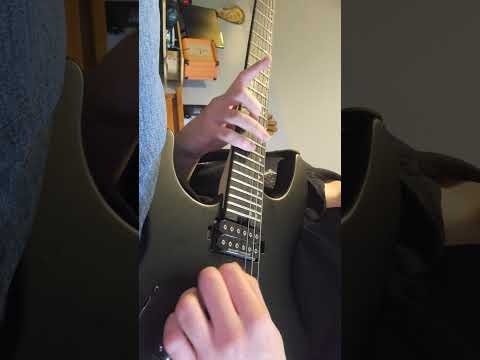
What I am trying to play is an ascending shred line in the 3NPS minor scale root position. I am warmed up. My fingers immediately recognize the shape, but the way that they progress up in it is obviously very inefficient. It’s uncomfortable, especially for my back, but I know of no better way to do it. I’ve tried several different fretting postures, and nothing provides the comfort and efficiency that I need to be able to play this simple thing. It feels like putting together an impossible puzzle.

Additional notes:

  • The D and G strings are where I start locking up badly.
  • I’ve never been hung up on things like this with my picking hand. My picking hand learns quick while my fretting suffers.
  • Descending lines are easier for me.
  • Here’s a video of me actually playing well. I was tense, but I was able to get a take of me playing cleanly: https://youtu.be/jQEOn3c9-WU?si=Wx6APUVjYPPSzehv

Nice playing! First thing I noticed as a critique was your fingers jumping away from the fretboard.

If possible, and this is something I’m also working on, keep your fingers as close to the fretboard as you can with as little tension as possible.

I understand this is easier said than done. Perhaps somebody better than us can explain and/or help out more.

1 Like

This is categorically false. Actively trying to keep your fingers close to the fretboard adds tension while improving absolutely nothing at all.

Cool. How can we help him then? I’d be happy to hear a solution.

1 Like

I’ve heard this conclusion before, but I forget the evidence as to why doing that “adds tension”. If playing accurately and with speed demands reducing the distance the fingers have to travel to fret, then shouldn’t you practice adapting to meet that criteria by some means? What should I be doing instead if it isn’t practicing keeping my finger pads closer to the fretboard?

@gw12505 @mwm you’ll both want to see the latter half of Synchronicity on fretting to learn more about what @eric_divers referenced. Sometimes it takes a big motion to go fast. See Josco Stephan huge motion tremolo as an example

Of course, there’s Tom Gilroy’s writings here on “efficient digital cycles” after thoroughly studying Shawn Lane’s fretting strategies

Hi @gw12505 .

The pattern of muscle activations you’re using for fretting is problematic.

You’re “lifting” your 1st finger by extending at the middle (PIP) joint, which implies activation of your lumbrical muscle. To fret, you’re then required to engage a muscle called flexor digitorum superficialis (FDS). This only allows for very limited activation of individual fingers, engaging it the way you’re doing is creating problems for your middle finger.

Coupled with this, your 2nd finger moves into an extreme position of hyperextension of the big (MCP) joint, with flexion at the small (DIP) joint. This implies a cocontraction between extensor digitorum communis (EDC) and flexor digitorum profundus (FDP). These are communal muscles which act on all fingers.

Then, due to the overactivity of EDC and FDP, you must forcefully extend your 3rd and 4th fingers, whatever way you still can. So, your extensor digiti minimi (EDM) which extends these fingers is activated, and you fret primarily through the activation of the interossei muscles and the hypothenar muscles.

This isn’t it at all. Playing guitar fast is as easy as wiggling your fingers.

This will not work without changing the actual pattern of muscular activation. He needs to retrain his movement patterns.

There’s two ways to make a movement smaller. You can either do it faster (higher frequency), or you can increase cocontractions. If the movement is smaller and you’re not playing faster, you’ve increased cocontraction, which is absolutely not what we want to do.

Small doesn’t make fast, and small doesn’t make easy. Easy enables fast and fast makes small. We need to start with easy.

You learn to apply the resting position of your hand to the guitar to achieve fretting postures which align your natural grip mechanics to fretting tasks. Nothing is easier than resting.

If your position of rest has the fingers in contact with the strings, then you don’t need to work to keep them close, and your movements will remain effective as they inevitably get smaller when playing faster.

9 Likes

There’s two ways to make a movement smaller. You can either do it faster (higher frequency), or you can increase cocontractions. If the movement is smaller and you’re not playing faster, you’ve increased cocontraction, which is absolutely not what we want to do.

Is this true for all movements? And does it also apply to trying to move more slowly?

This isn’t specifically for guitar, but information I’d like to have.

If we specifically want small, slow movements with low power, then we can also make movements smaller by using less force.

This might be valuable in other contexts (brush control in painting, maybe), but it’s not relevant to developing fretting hand technique (or picking technique). If we have small movements with minimal force at low frequencies, they’ll be too small and too weak to function as we increase the frequencies. Power and range of motion are good things.

But yes, this applies to everything. The nervous system only controls the number of motor units recruited and the timing of the contractions (force and frequency).

2 Likes

And here I was not tagging you so you could stay focused on wedding planning

3 Likes

Thank you. This is great.

Since applying the resting position and just relaxing my hand isn’t a simple lever I can flip, are there any practical ways you’d suggest I fix my movement patterns?

1 Like

I appreciate you.

I’m always happy to help.

I’d love to tell you that it’s a quick fix, but it’s not.

I really don’t have time to make video on this for you, but here’s some older videos I made for other users.

I have a much better understanding of all of this now than I did back then, but this is what I have available to me right now.

Watch them and see the fretting postures I demonstrated. Find the resting position of your had and apply it to the guitar to achieve those positions.

Don’t ever think “relax”, it’s not helpful. Instead, think “reset”, returning to your resting position and finding your fretting posture through haptic sensitivity.

Do this consciously/mindfully for just a few minutes a few times a day. The rest of the time, just reset frequently as you play to habituate lower background tension.

8 Likes

Thank you for the suggestions. I’m going to apply this advice earnestly and see what comes of it

3 Likes