A quest for Jimi Hendrix’s faster-playing style solutions

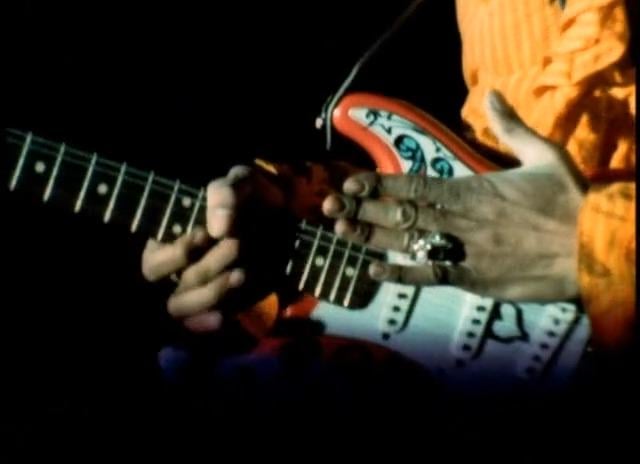
This answer is likely not as specific as you would have liked - and since you’ve already delved into all that is available, you’re probably already familiar with it -, but I have learnt a lot from the live performance in Stockholm. The quality of the images is good, especially considering the time of the recording. And you get a good view of his right hand in faster passages. Amongst other things, his sweep is demonstrated.

3 Likes

That’s cool that he did sweeping

3 Likes

I did, ages ago, find a live video of Jimi playing that featured some great close up picking hand footage of his “Red House” style blues lick - the (in B) bend the G string 9th fret, then follow it with the B string 7th and e string 7th, then a 10-7 pull off on the B. You could see a pronounced downward slant, and he definitely swept the three ascending notes, which really helps get the very slurred feel he plays that run with.

I think it may be no longer online, but I was so excited about the footage I immediately posted up about it here. :rofl:

3 Likes

@drew did you notice trailing edge as well? Also new info for me lol

I didn’t, and no one commented on it in the thread:

…where the videos have, indeed, been taken down.

Someone shared the video from his acosutic “Hear My Train a ‘Comin’” performance which does have some good picking hand video as well, and maybe slight trailing edge, at least while playing acoustic seated? Doesn’t necessarily translate to standing posture, but…

1 Like

This has actually been very helpful! I had been looking specifically at the video of Red House from that Stockholm show, but once you pointed this out, I looked up the whole concert. I think it probably has enough good clips that I can start to draw some conclusions. So, thanks! Great tip.

I’ve continued to study and experiment with Hendrix’s (apparent) mechanics this week, and I’ve been noticing some interesting things just in my own playing:

  • It’s pretty tough to get a fast, consistent tremolo with his picking hand technique. The grip on the pick doesn’t have as much strength as most of the other styles I’ve tried. But I think Hendrix might have just actually had a fairly slow top tremolo speed. There are examples in his music of his tremolo, and it’s frankly just never that fast.

  • However, what that pick grip DOES get is a sense of “looseness” that translates to REALLY easy pick flips for reversing direction after a sweep. I already suspect that the main driver of his fastest playing is going to be legato combined with sweep mechanics; the pick grip seems to support that.

  • His pronated fretting hand and use of the second finger for longer stretches than usual does seem to “suggest” or “enable” some of his idiosyncratic note choices during solos. I don’t have a clear way to articulate this yet, but the second and third finger have some interesting interactions when you use both of them for longer pentatonic stretches.

I’ll continue to post updates here if and when I can learn more!

2 Likes

It was neither especially fast, nor especially even. Purple Haze is a great example, with the Octavia outro part - it’s fast, it’s cool sounding, it’s groovy… but it’s not THAT fast (as a kid just trying to learn this stuff I never felt like the picking for that part was out of reach, whereas a lot of the fretting hand stuff rook some work) nor is it, while in the pocket, mechanically tight. It worked but he definitely pushed and pulled things a bit.

Should start right at the octavia part. He’s sort of “pulsing” the tempo, to my ears.

1 Like

Yeah! Solid example. I think also of some of the soloing over the outro of “Gypsy Eyes,” where he does a bit of tremolo playing. I’d characterize his tremolo, generally, as “relaxed” instead of intense. Playing around with his picking mechanics, it seems like it would be pretty much impossible, or at least pointlessly hard, to get much faster tremolo without altering some aspect of the picking hand technique.

His fretting hand, on the [literal] other hand, is pretty dang fast by anybody’s standards, especially once you consider that he’s basically never doing 3nps phrases. The number of fretting actions per second is impressive.

2 Likes

When you discuss “tremolo” here, I’m not sure what you mean? When I hear “tremolo” in the context of picking I think of tremolo picking like Van Halen tremolo picking the Kreutzer etude melody and I don’t hear that type of tremolo picking in the outro soloing on “Gypsy Eyes”. Unless you are using “tremolo” as another way to say “fast picking”?

I love the topic by the way…this kind of stuff is right up my alley. I love Hendrix and as was said, his playing style is pretty easily grasped, even his faster passages are nowhere near the type of speeds that this site was created to address. But I totally get why the actual mechanics of what Hendrix did is absolutely worthy of study…even if you never perform a single Hendrix song live in any context, I think seeking this kind of knowledge can lead to an even deeper appreciation of the material as a listener and as a guitar player.

2 Likes

That’s great that you are studying Hendrix’s technique carefully! I love his technique, though I have not studied it in the detail I believe you are studying it. (Caveat: I’m about to make a couple observations that many here may disagree with, and I do not mean to say that I am right - just expressing my personal aesthetic tastes.) Two things that I think are underemphasized by many guitarists are feel and sound. Feel generally seems quite connected to right hand looseness - I realize that many shred folks love music where the guitarist has an incredibly stiff rigid picking style, but that often just feels tense and kind of ugly to me. Check out how extremely loose and relaxed Hendrix’s picking hand and arm are - I’ve never seen that looseness in any Hendrix imitators, incidentally. (A couple other examples of beautifully relaxed picking in different styles: George Benson and, though not quite in Hendrix territory, Prince). Similarly, sound is much more shaped by the details of how the pick attacks the string than I think most guitarists are aware - and Hendrix played with a wonderful variety of sounds. There are certain guitarists whose fretting hand is so strong that it kind of “covers” for their weaker picking hand, and I’m not saying that was true of Hendrix, but just pointing out that, with his big strong hands and long fingers, his fretting hand was remarkably powerful. Please share with us more of your detailed discoveries as you make them, studying the existing videos!

2 Likes

It’s been really fun so far diving in on Hendrix’s playing solutions. I haven’t really found any new groundbreaking stuff yet that I didn’t mention already, but as I continue to dig, I’ll just document my thoughts on little details here.

  • The use of his middle finger for pentatonic playing seems to really unlock a lot of his left hand phrases. Specifically, having two different bend-capable fingers (middle and ring) at the upper edge of pentatonic boxes makes a lot of Hendrix legato-plus-sweeping fast licks very intuitive; I’ve really gotten used to playing this way in a pretty short period of time. It’s very acquire-able, as a style.
  • That middle finger in pentatonic box 1 is systematic (i.e., he “always” uses it) in Hendrix’s playing for the notes on strings A, D, and G, and occasional on B and high e. When he uses middle finger on the two highest strings, it’s usually for either a shorter stretch (outside the pentatonic box, in a Dorian-mode style) or because the ring finger is already occupied with another note on those same strings.
  • His predilection for sweeps isn’t universal in his fast playing. A lot of quick runs use pretty “normal” Eric Johnson style downward pickslanting USX alternate picking mechanics, although not really for the kind of sustained speed EJ might use.
  • However, when he plays fast repeated triplets across two strings, he does tend to use sweeps for those.
  • He’s playing with the pads of his fingers, the fingerprints, rather than his fingertips, typically. The last two knuckles of each fretting hand finger are often pretty much in straight flat lines.
  • He’s not afraid to do passages of lead playing with all legato, pick nowhere near the strings, even with string changes, using hammer-ons from nowhere to carry him through runs. The fuzzy tones he used live make this playing not very distinct from his picked playing, since virtually all of the attack of each note gets fuzzed out, regardless of whether it’s picked or legato.
  • He’s at least as much a fuzz face and volume knob master as a guitar master–but this mostly gets expressed as larger-scale tone “settings” than changes within a single passage of playing. That is: Hendrix would set his guitar volume knob and pickup selection at the start of a song, and then mostly keep that consistent through the song, possibly tweaking it for solos or big dynamic changes. He uses the volume knob and pickup selector switch musically, but he’s NOT constantly fiddling with them.
  • Pentatonic box 1 is the home of maybe 90% of his lead playing. When he ventures outside it, it seems more like he reaches for fairly consistent “stock” vocabulary licks rather than wild improvisation in other positions.
  • That man could and would bend notes into outer space. It’s crazy that we don’t have a ton of clips of him breaking strings onstage.

If I could put just one word on his style as a whole, it would be “freedom.” He developed a system that allowed him to play through some pretty varied material while totally relaxed, able to just let ideas and sounds flow. I’m having a blast picking it apart.

3 Likes

Based on several of your observations in this thread, I recommend you take a look at this other thread if you haven’t already seen it: Videos on fretting principles

There are several videos in that thread and I recommend you watch all of them. The topic is not specifically about Hendrix, but about the fretting hand generally. Tom Gilroy is a goldmine of information about this sort of thing.

3 Likes

I really don’t have time to write up detailed comments now (I’m getting married on Monday), but I’m looking forward to digging into this topic a bit more in a week or so.

I’ve never analysed Jimi Hendrix’s playing to the depth that I’ve studied Eric Clapton, Eric Johnson, or Shawn Lane. Mostly for the reasons that have @Achilleus has already mentioned; you can play Hendrix almost verbatim with a lot of different mechanical approaches, and the surface level details allows for a passable imitation.

However, mechanics and phrasing are intimately related, we play what we feel sounds best out of what feels available to us. The kinaesthetic experience of playing informs what we choose to play.

I think exploring Hendrix’s playing again would be interesting, now that I have much more knowledge and experience in this type of analysis.

I would mention that the size of Jimi’s hands is usually exaggerated online. He had long fingers (some think he had Marfan’s Syndrome), but this picture gives allows for a clear estimate of his hand size

jimi-hendrix-hand-size-v0-5r6rzqdosyae1

Larger than average, but not unusually so.

4 Likes

An early congratulations to you and the bride @Tom_Gilroy!

4 Likes

Congratulations and well-wishes, Tom! And a belated thanks for your book recommendation on How We Learn to Move; it’s been a game-changer for me personally in areas completely beyond music, and it’s made me a better teacher as well.

I’m a huge Tom Gilroy fan. My ability to make any sort of useful mechanical analysis on subjects like this one is completely indebted to his work that he’s shared on here in the past, and I think some of his discoveries (like “efficient digital cycles”) are the most useful and cool advances in guitar technique since Troy’s work with escape motion.

As I’ve continued to pick apart the footage we have of Jimi, I feel like I’ve hit a point of diminishing returns on his mechanics per se—the things I’ve mentioned in here pretty much take care of any oddities beyond what the standard CTC guitar science already covers. There’s still more, for sure. For example, I want to get a better bead on his vibrato and bending strategies, and how he typically chooses among them in a given context.

But I also think that the next steps in my analysis will probably be focused more on his vocabulary, and trying to track down which licks and ideas he’s most likely to use moment-to-moment. This has always been the biggest mystery to me in Jimi’s playing—not HOW he plays the notes, but WHY he chooses those particular notes in those particular contexts. Breaking down his lead playing has already helped me identify some of his stock patterns that I wouldn’t have ever spotted as such before.

Example: in pentatonic box 1, a SUPER common pattern he deploys in basically every song and performance is: bend G string up to unison with B string with middle finger, play two more notes on B and/or e strings with first finger, play a fourth note with ring finger. The actual notes vary somewhat but that “middle, index index (barred), ring” pattern is pervasive.

Another similar pattern is “descending legato sweep with ring and index finger, followed by bend with middle finger,” again on the three treble strings. The details change, but that’s absolutely a theme of his.

EDIT: oh yeah! and he exclusively uses his palm on the back of the neck to oppose his fretting actions, never his thumb. Almost goes without saying, given his use of thumb for fretting.

And he tends to anchor his picking hand during fast passages with his ring and pinkie fingers down around the edges of the pickups or curled up touching the high e string.

5 Likes

I just want to express my appreciation for this CTC-styled deep dive into my undisputed GOAT’s playing.

Between the myth and the genius, there are so many layers to unfold that I never really got as far as to evaluate his mechanics. Really valuable stuff.

3 Likes

Returning to this to just underline the most significant-feeling stylistic element that I’ve found, at least in my personal opinion: the fretting hand middle-finger strategies.

Even in Jimi’s chord playing, there have been a few musical moments that have never quite made intuitive sense to me regarding how you’re “supposed” to fret those sequences (“Castles Made of Sand” being one hotbed of weird fret movements). They’re not so fast that you can’t just… GO there. But it’s never felt right to just quick-jump from one position to another when playing Jimi’s music. As noted above, he’s got such a relaxed feel that any “jittery” movements with either hand seem out of place, even moreso in a relaxed-tempo song like “Castles.”

What I’m finding as I crawl back through his recorded output with his fretting technique in mind is that a lot of otherwise puzzling fretboard movements become trivial if you’re using your middle finger preferentially for two-fret stretches. The ring finger, instead of being the main player in pentatonic runs as it is for most guitarists, instead occupies a “backup” position where it gets used only when the middle finger is already otherwise occupied. This can facilitate position shifts, string skips, and more complex bending strategies, and it results in a very distinct pentatonic vocabulary.

I’ve been fairly surprised just how rare his pinkie use is, even in chord playing.

Here are a few of the tendencies I’ve been becoming increasingly confident in:

  • if you hear a slide up to a sustained note with vibrato on it, that’s almost definitely index finger.
  • you’ll hear a slide accompanying virtually every position shift in his playing. If the notes are unadorned with legato of some kind, he’s probably in a single fretboard position.
  • listening very closely for the “in-between” note on a two-fret movement, to distinguish whether it’s a slide or a hammer-on, can help clarify when he’s actually shifting vs. when he’s playing legato in a single place.
  • he had slightly different fretting hand “gears” for major vs. minor soloing and chord embellishment, with his bluesy playing being built off the minor version. He might switch between them at a moment’s notice or as he moved between chords, but they’re distinct enough that I feel comfortable saying he (at least sort of) had two different “toolkits.”
1 Like

Congratulations, Tom! Best wishes!

2 Likes

Big breakthroughs today on “Castles Made of Sand,” which has for years been at the top of my “I can play it fine but it just doesn’t make sense” list: the strange Bb (real pitch A; fret 6 on the low E string) in the intro and choruses is played with thumb, and the even stranger F (fret 8 on A string) is played with ring finger. If this is true, which I’m increasingly confident it is, the whole bizarre passage makes a lot more sense, both technically and (bear with me) harmonically.

Jimi’s thinking of the whole song in relation to the droning open G string. I think it’s very likely that the sliding, ambiguous add9 chords in the intro and outro were the first part of the song he came up with, and he built the whole song structure based off of the possibilities that offered him. He’s looking at that clean section of the “Castles” intro (after the reverse guitar and chime-y chords, before the verse starts) as chords:

Intro/Chorus

G major: walk it up through the common bass arpeggio.
B minor: standard pentatonic box 1 stuff… until
C6sus2: yes, I am proposing a chord nobody has ever considered here, and I’ll justify it below.
A minor: more pentatonic box 1 stuff. I think the C commonly notated on fret 3 of the A string here is misplaced in tabs, and I’m betting it was on fret 8 of the low E, played with Jimi’s ring finger.
Bb6sus2: same as C6sus2 above. (You could also spell these as e.g. C6/9 (no 3rd) if you’re jazzy.)
[[G major
Bb major
C7 (another new one I’m proposing)]] x2

The [[double bracket]] section is what I’ll refer to as the “turnaround.” It always repeats twice, except for the solo, where it forms the entire background on repeat.

Verse

F sus2 (he never plays a 3rd at all over F in the whole song)
A minor
E minor
F
C
G [[turnaround x2]]

Repeat: this is my best guess at how Jimi was thinking of the harmony in this song.

The weird 6sus2 chords:

I think Jimi built these based on a hand-position shift that’s available to him via using his thumb. One potential reason he worked so much within the common pentatonic box 1 is that it’s easy to make the matching minor chord without altering the fretting hand position. If we consider a Bm7 barre chord in his system to be:

e 7(index finger barre)
B 7(index finger barre)
G 7(index finger barre)
D 7 (index finger barre)
A 9 (ring finger)
E 7 (thumb)

—then my proposed chord concept of C6sus2 is as easy as just shifting the thumb and ring finger up a single fret together, resulting in this:

e (mute)
B (mute)
G 7(index finger barre)
D 7 (index finger barre)
A 10 (ring finger)
E 8 (thumb)

This is EXACTLY the chord shape that he undeniably uses for what I’m labeling Bb6sus2 at the 0:14 mark in the song. I’ve almost always seen this chord played by others fingered as

G 5(index finger barre)
D 5 (index finger barre)
A 8 (pinkie)
E 6 (middle finger)

—which is a perfectly good, comfortable way to play it verbatim. It makes sense in every context, except for how the hell did Jimi come up with that?

Well, if my guess is right, then it’s easy to see how he’d come up with it. He just kept his index finger still, and shifted his thumb and ring finger up a fret, basically raising the power chord at the bottom of the chord voicing by a half-step.

I bet Jimi was NOT thinking of them as “6sus2” chords verbatim, although I think he did have a fairly sophisticated harmonic vocabulary, via his time with Little Richard and the Isley Brothers. I’m betting he was thinking of them more in terms of “lifting the A minor up to Bb, but keeping the A minor notes in the middle strings.”

Maybe, but WHY would he come up with that?

I’m going to revisit the overall harmonic structure again:

Gmaj (root/I) > Bm (iii) > C6sus2 (IV)

Keep this I-iii-IV in mind for later. Then:

Am (ii) > Bb6sus2 (bIII) > [[turnaround]] [[Gmaj (I) > Bbmaj (bIII) > C7]] x2

Okay, that C7: it’s fingered identically to what I’m calling Bb6sus2, with one exception: the A string is muted.

“C7:”

e (muted)
B (muted)
G 5 (index barre)
D 5 (index barre)
A (muted)
E 6 (thumb)

So I WOULD call it the same chord, except for this: at the end of the turnaround, it sets up a return to the verse section, where the chord is F major (thus, a V7 > I resolution / cadence), and when this happens, Jimi never plays the 8th fret note on the A string. He mutes it every time he’s going to play F next, and he plays it every time he’s going to play G next. Maybe a coincidence! But whether it is or not (and I think it isn’t), it does have that effect.

I’m going to have to revisit this later tonight after I’m done teaching to talk about what the verse does. Quick version:

Fsus2 (I) > Am (iii) > imply C with low E string note (IV)(new key center I) > Em (iii) > imply G (IV)(new key center I) > F (bVII) > C (IV) > G (I)

So it’s a stack of overlapping I > iii > IVs. Neat!

Tangent: another detail that I think arguably supports these harmonic ideas:

The bass drops out completely in the choruses, where this harmonic motion would be harder to follow, and it just sits on the G in the turnaround at the end of each half of the verses, and also simply sits on G for the duration of the entire guitar solo, while the rhythm guitar repeats the turnaround motif. I think this is probably due to Noel Redding not knowing quite what was going on in those sections, and Jimi likely not being able or willing to explain it to him. (They notoriously didn’t work together well in the studio, often due to Jimi’s lack of clear communication skills about what he wanted; during the Electric Ladyland album, Jimi would reportedly get Noel to do so many takes that Noel would leave in frustration, at which point Jimi would go and record the bass lines he wanted himself.)

2 Likes

New mechanical discovery, medium confidence level: Jimi’s pull-off technique at least included what I’d call a “flick-off” motion of his fretting finger.

I, and (I’d expect) most people, tend to perform pull-offs with a slight curling action of the fretting finger. In close-up video of Jimi performing a quick repeating five-note motif here ( https://youtu.be/EDaYPV7lrkY?si=E4Cz27ZKmjMyBhzu&t=386 ) we can see that the 8-5 fretting sequence on the high e string uses his ring finger with a distinct extension motion as it leaves the eighth fret.

These notes ARE picked, not pure legato, and as such don’t demonstrate clearly that he used this “pushing/flicking” extension motion for pure pull-offs. But I think it’s very likely that this is responsible for many of the quick apparent “micro-bends” in his faster playing, e.g. throughout the fills in Red House. This type of movement would also just be a totally natural consequence of small bluesy bends on the “upper floor” of any given pentatonic box.

I’d bet this movement is already intuitively familiar to anybody who’s ever learned a Chuck Berry riff.

I also think Jimi almost definitely used the more common “finger curl”-type pull-offs too, and may have preferred them. But now that I’ve spotted the extension pull-offs, I’m going to keep an eye out for his tendencies as to what contexts he uses that movement for.