
6 Likes
Quick and easy one-pager on garage spikes with some cool illustrative GIF animation loops to really make this obvious. We also make these for players who hit us up in Technique Critique, and it can really drive the point home in a simple way when you see this in your own playing.
More generally, before I started doing this for a living, I never would have guessed how common certain basic problems are. Stringhopping, for one. It was something I encountered only when trying to switch strings against my (most likely) self-taught USX technique, which I was unaware of at the time. But on a single string I don’t think it really happened. It never occurred to me that some players might learn this even on a single string, on every note, as their actual full-time primary picking motion. And two, garage spikes. Super common – maybe the most common picking problem alongside stringhopping.
What’s particularly problematic about both of these is that they are radical early gates. If they happen, you either can’t play very fast, or you can’t play at all. It’s clear there are probably lots of players who hit these roadblocks early and made significant choices in response: maybe switched to legato / sweeping, maybe switched to keyboards, etc.
5 Likes
Troy, one (perhaps silly) request. When recording things where we’re going to be analyzing everything about the motion, could you perhaps not wear jackets to the wrist? The Joe Pass video snippet you included in the email for this is an example. There’s forearm rotation going on which is apparent even with the jacket but (and maybe it’s just me) I know I’d like to see that arm.
Thanks again for all the valuable info!
1 Like
This was absolutely my case - can’t tell you what exactly the problem was, but I was never any good at picking, so I just did a LOT of legato practice.
It works, and it comes with its own vocabulary and style and phrasing and all the like, and you can build a totally viable “style” around it. Joe Satriani actually can pick well enough, and he did this largely by choice.
but, there’s also a reason today that I’m here and I’m unlearning bad habits and building a, maybe not new but certainly expanded vocabulary, of things that work well for the way I DO pick (and, ironically, those choices are starting to inform my legato phrasing as well).
Sweeping, maybe you can be a stringhopper and still sweep, but you pretty much HAVE to fix the garage spikes isse to sweep. And I think I did spend a little while truing to learn some sweep licks and it did seem to actually help my regular picking, so I suspect I was a victim to garage spikes, come to think of it.
1 Like
Of course! The Primer is very consistent on this. This was a fun thing for YouTube where we wanted to mirror the old Joe clip.
This was also not intended to be a tutorial on how to actually do a USX picking motion. I was clear on that - otherwise this would have been a much longer video. The main takeaway from this lesson is that it really doesn’t matter which USX technique you use, only that upstrokes escape. So for this lesson, the jacket fits! (Ha.)
Finally, I understand that the tremolo demonstration looks like forearm - it is! But that’s somewhat idiosyncratic to me. It’s the only part of the lesson that really uses this motion, and not something I intended anyone to specifically mimic. The two-handed playing is mostly wrist with relatively little forearm, especially on middle and lower strings. This is similar to what Joscho Stephan does. Here is what it looks like - if you watch the forearm you will note how little it actually rotates most of the time:
3 Likes
I think two-way economy types can probably still have a garage spikes problem if they don’t do much actual alternate. Note that garage spikes is specific to alternate, since it only happens on one of the pickstrokes - either the downstroke or the upstroke, but not both. It’s the “one way” nature of the problem that makes it like the parking garage spikes.
If you’re saying more generally that sweeping forces you to figure out smooth attack when sweeping in whichever direction, yes, for sure. But I can easily imagine a person who can do a five-string sweep in both directions, but when they try rapid alternate picking on a string, they get the spikes issue. It’s sort of it’s own animal.
To put this another way, we have definitely worked with players who had a decent two-way economy type vocabulary, but couldn’t tremolo, because the style doesn’t expressly require it. I’ve come to understand that there is a subcategory of players who moved toward economy because alternate is not obvious to figure out. In other words, I think economy is chosen very often not so much because it’s “economical”, but because it might be the only way a player can figure out how to get certain lines at all.
Let me know if I’m understanding you correctly!
2 Likes
Or in my case, abandon the plectrum altogether in response to my seemingly implacable stringhopping and try to cultivate a right hand style around fingerpicking.
It took me a while to come to my senses and realise that trying to get the fingerpicking up to speed was even more difficult! In any case, I discovered a knack for circular picking, thank goodness… But I still practice hybrid picking. The string hopping is now a distant memory, but having said that, I can definitely tell when I’m picking something and it doesn’t feel smooth or efficient, even though it’s not stringhopping as conventionally understood. I recall this feeling even when doing something involving a rest stroke which is supposed to act against stringhopping. I guess there must be more than one wrong way to pick…
1 Like
Yes there are tons of things that can be working less than optimally. It’s kind of ridiculous how many of these gates or filters exist in playing with a pick. And again, it’s only after having done this work that I really started to appreciate this.
Once you start seeing people in bands where soloing is a thing – forget about the famous people – you’re already seeing the people who made it through the filter. We generally have no view on all the ones who tried flat pick guitar and couldn’t get basic technique on a single string happening.
In your case, when a line feels weird, I’d probably film it. If something feels off, it’s probably something you can see.
1 Like
You are, Troy. Specifically this:
It got some gears going for sure.
My tremolo picking isn’t expecialyl great either, but that seems like its something else, like the lag between downdstroke and upstroke, and upstroke and downstroke, is different, somehow. It
s made that machine-gun-like Gilbert sort of picking sound tough. That’s getting smoothed out from repetition though, and I’m starting to occasionally fgeel like that machine gun effect is happening. I think here it’s just lack of practice because it hasn’t been a big part of my style for, well, most of the 30 years I’ve played. 
I would hesitate to attribute anything to purely practice at this point. For example, on your “delay between upstroke and downstroke” comment:
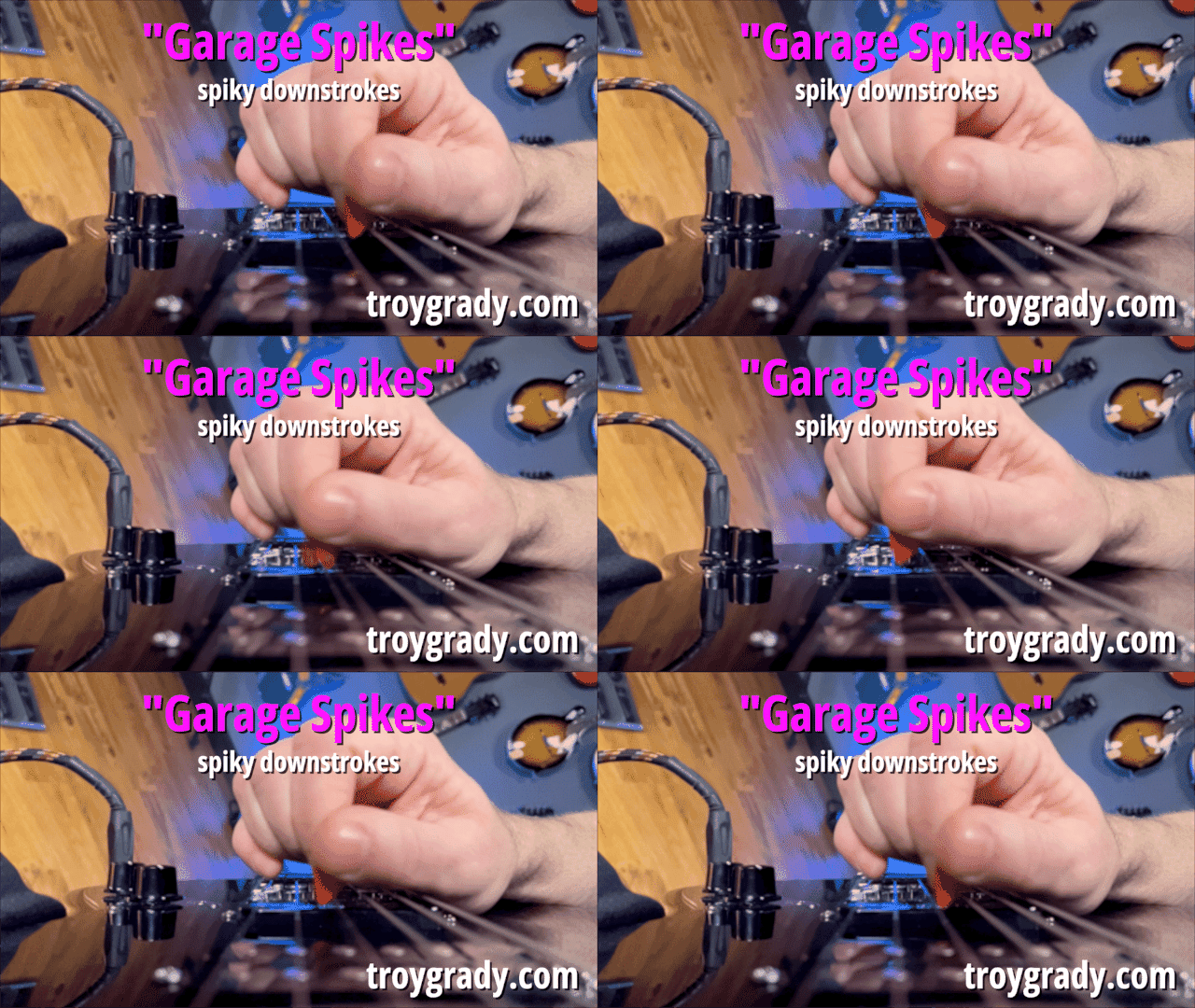
Garage spikes can definitely cause that, and you can SEE it. The downstroke pauses as it snags on the string, shutting off the sound too. This is not a thing that “practice” fixes, per se. The only way this gets fixed is if you change the technique. If you do a thousand reps and your technique is different, that’s not really repetition – that’s change.
The problem is, good players may reflect on their progress, and think, well, I had this problem, then I did a thousand repetitions, and now I don’t, therefore I was sloppy / inaccurate / etc. Insert whatever reason you like. Just because I think I know what caused a thing doesn’t mean I really do. Video is one way to cut through the noise.
3 Likes
I had an issue with my picking which resulted in involuntary swing all the time in a non-musical way. The problem was an acute case of garage spikes.
Also, I think the garage spikes problem can be exacerbated by arbitrary expectations eg. “I have to play USX”. Even if you are familiar with the CTC concepts, that kind of self-imposition is a progress killer imho.
On that note, I think the CTC content might inadvertently bias newcomers due to how spectacular and shiny USX looks eg. entire seminars on Yngwie and EJ, and lots of content on Gypsy technique, whereas the DSX style might give the unfair impression of being the “ugly duckling” of picking that you have to settle for, when either escape is factually as good as the other.
Personally, I have the impression that if it weren’t for @tommo ’s fantastic work on the Metronomic Rock seminar, the DSX style would barely have any presence in the CTC catalog besides the explanation of its mechanics.
2 Likes
As someone with the opposite problem (I must have dbx or bust), I think that in at least the sense that many people seem to have this hangup, you’re right here, from a completely unscientific vibes-based analysis of the posts I see on the forum. Flip side: this isn’t really the gang’s fault. All of the material stresses that both are good!
1 Like
I think it might be a matter of structure and marketing (way above my rank as a simple subscriber ) because I for one joined the forum like a moth chasing the light while thinking “Oh look! Yngwie!”. For DSX content, it’s there for sure, but from my subjective position, it seems more obscure and I would love to see a light that brings guitar folks in while thinking “Oh Paul Gilbert!” or something like that.
1 Like
I mean, Troy’s “native tongue”, so to speak, is USX, so this makes sense. And for whatever reason, the single escape USX style (Yngwie plus clones, EJ, Gypsy folk, whoever) appears more common than the single escape DSX style (Jeff Loomis, Andy James) among well-known players. Not sure classifying Gilbert as DSX is totally accurate, either, since he routinely does certain things in not-DSX-friendly ways.
Sincerely,
a mostly DSX guy
I think Anton Oparin did a break down of Paul’s playing and basically said that Paul swiped all his upstrokes when playing full speed and was just good at muting the sound to an extent that most people can’t hear the extra noise or at least decipher the sound as such.
1 Like
Maybe in the Gilbert lick at his fastest, but definitely not in general all the time. I’ve seen that vid and Anton cherry-picks the worst examples. Getting OT, but here is Paul economy picking 3 nps scales back in the day. He couldn’t do that ascending if he were strict DSX, but he breezes through it pretty easy.

After discussing technique directly with him on another website and attentively watching him from about 2mts away for a couple hours last week, I feel confident enough to say he is primarily a DSX player with a beautiful touch to find the sporadic helper motion when needed.
3 Likes
Honestly I’m inclined to agree with Anton’s assessment simply because Paul’s right hand wrist movements, in terms of changing angles, seem too minimal to cleanly execute two way pick slanting - or whatever the current terminology Troy has coined in terms of Paul’s picking technique.
At the same time I don’t think it matters much if at all because I never noticed it or could possibly hear it until it was specifically pointed out and even then it’s so minimal as to be entirely negligible, imo.
Anton is clearly obsessed with picking perfection to a level that 99.99% of all humans would never pick up upon.
That’s the issue with guitar lol, it can never be truly divorced from the “athletic” aspect of technique and the competition it inspires therein.
1 Like
Especially on those quick direction changes! I’ve struggled with getting snagged there before!
Does anyone have a video on transitioning from a garage spikes to a non-garage spikes picking motion for usx?