Hey guys, I was wondering, how would you pick this?
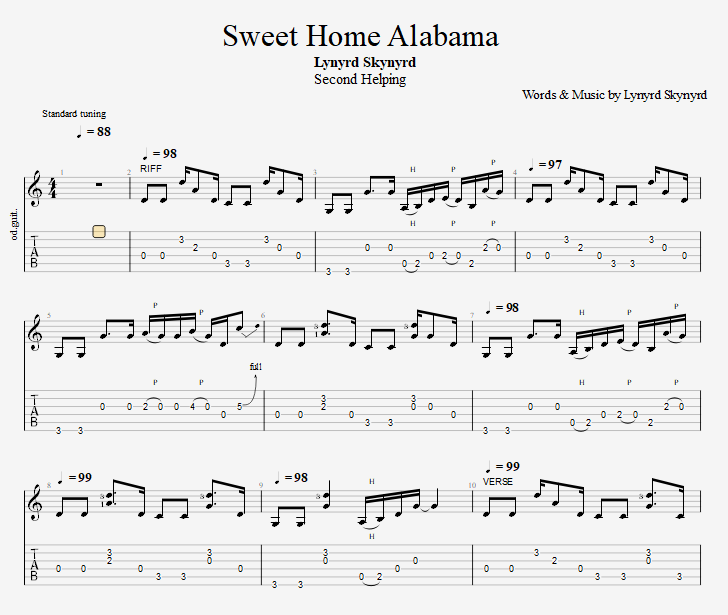
What would be the most logical approach? If you can show me the pick notation direction that would be amazing. Maybe we can also discuss why you chose to pick the way you did.

Hey guys, I was wondering, how would you pick this?
What would be the most logical approach? If you can show me the pick notation direction that would be amazing. Maybe we can also discuss why you chose to pick the way you did.
Sixteenths at 98bpm is well within the “it doesn’t matter” range, honestly.
That being said: D D D U U D D D U U for the first bar, I think.
Basically what Eric said.
Trying to be a little more specific, I would only focus on playing the 8th notes that signal the chord changes as downstrokes to keep the groove going. Besides that, I wouldn’t care much about the rest of the pattern.
So how exactly do I “crack the code” of a line or lick or phrase that Im trying to learn? Like what should the logic be behind the “D-U” pattern I use?
For example why did you start with DDD? Why didnt you do D-U for the first 2 notes? This is the kind of thing I wanna understand deeper
He’s just following the rhythm à la 16th note strumming, which is what I’d do, as well. Basically , 1 e & a is D U D U. If you play 1 &, that’s D D. 2 e a, in the second beat, becomes D U U.
Even better,
If you can show me the pick notation direction and if you escaped or not that would be amazing.
I always tried to get people to use a slightly more descriptive notation but failed:
You’ll note that everyone will usually tell you the direction and then you have to read the tea leaves and try to infer both d vs. D as well as u vs. U, although there are hints that add constraints:
Ok but what about the SLANTING??? What pick slanting would you use, and how? How would you slant each note?
Doesn’t matter. It’s pretty slow
You are overthinking.
Pickslanting and all that only yield benefits in the context of really fast playing (think 10+ notes per second). This is just a mid tempo rhythm part and virtually any picking variant will most likely sound good enough. You can string hop the whole thing with zero pick slant if you want and it wouldn’t make a difference.
Well this is 5.8/s at 88bpm, but what if OP wants to go faster, should they suddenly learn a new way to play it, or should they learn it just once?
I don’t know the right answer here, but would uniformly applying the fast technique result in better use of the metronome and more solid technique overall? I don’t know, you tell me!
I’m confident you know it: in CTC terms, that sounds a lot like Warp 1 territory. Fundamentally irrelevant for speed, imho.
I don’t see the benefit in shoehorning a “what if” to answer such a clear question.
We see, in the sense of biology, that many players have inconsistent technique that is broken up as Warp 1, 2, and 3. Now, (a) DOES IT HAVE TO BE LIKE THIS — e.g., is that unavoidable? — or is it (b) a consequence of their irregular and improper practice and “training?” I haven’t heard Troy say just yet, but MY GUESS is that it’s (b), unnecessary behavior due to practice regimes that are all inconsistent.
The reason I think that it’s (b) is that classical musicians don’t talk about “Warp 3.” Where is this in violin, for example? It doesn’t exist, their teacher would slap it out of them. The only place where I have heard people debate the utility of a metronome is… the same place they talk about Warp 3. Talk shit about a metronome to one’s piano teacher and prepare to be slapped.
Indeed, let me throw out a postulate: You won't see "Warp 3" in a gypsy jazz player, they'll likely do the same thing at every speed. (This is a postulate, I have no proof.)
So, back to OP. Is OP really overthinking? No, not at all, OP is asking a great question. But I think that OP should be careful about being self-taught, and seek out a great teacher; there are not so many of them in guitar, but certainly enough where OP will be able to become a great player should OP spend the effort to find one.
Pretty sure you will. The reason is that good fast technique doesn’t sound good slow.
If the classical method applied to electric guitar, this website wouldn’t exist.
The rabbit hole of the endless possibilities you can find for virtually anything in the universe, in my experience, usually amounts for a great recipe for getting stuck in imaginary scenarios when I would have been better off doing something else like, say, learning how to play Sweet Home Alabama.
Do you yourself actually have any experience with the classical method on any instrument?
Sounds like a good project for you @kgk. How fast can you play Sweet Home Alabama’s intro keeping technique the same from slow to fast? What say you?
That is interesting, I never realized that. Can you explain why?
Me? No. My better half is in the classical world (conservatory, perfect pitch, etc), however, so I regularly interact with those types of people and get ask them a wide range of questions. Some of my questions involve things that I have read here.
I try to lay out every piece of music in accordance with clear escapes, etc., as my hope is that uniformly addressing all music will eventually have benefits. I postulate that clear escapes even with the metronome at 60 bpm is good, but I really don’t know much, and that’s just guessing on my part. But I’d be really curious to see Anton at 60 bpm on a Magnet, my bet is that he’ll look about the same at any speed.
I think the whole forum would get a kick out of SHA at 240 with whatever technique
For what it’s worth, a bunch (all?) of the virtuosos in the interview section change their technique when playing slow, starting with one of the most gifted players in the business, Andy Wood.
Troy explains exactly why that is not the case in the Warp 3 video: