Thank you for sharing that. I have no doubt that for the majority of people — self-taught in particular — who are making no serious sustained attempt to have a homogenous technique that there will indeed be disparities between what they think they are doing and what they are actually doing.
What I meant to postulate is that if a graduated student was trained by a legitimate gypsy jazz teacher they will likely be doing the same technique at both low- and high-speeds, as the teacher provided the feedback loop to enforce homogeneous technique.
Sorry, English wasn’t my first language, so I might be a little difficult to understand sometimes — my apologies. I suspect that EVERYBODY that goes through a formal training pipeline with metronomes and the like will NOT exhibit this “Warp” behavior, and that it will mainly be seen in self-taught people. Do I have any proof? No! But what makes me suspect that this holds is that I never hear about concepts like this from people that have ideal training (starting as children and going through the classical training pipeline).
I’ll play devil’s advocate and repeat an observation I had mentioned in some other post here: I can lace my shoes up super fast, despite never having practiced to do so. When I was very little I trained the proper sequence of motions, and now I can just bang it out - I don’t even know, on a conscious level, what I’m doing.
So maybe, if you truly know the proper motions to make, you can transfer this observation to other skills, like guitar picking. But I think the reality of things here is that members mostly arrive with years, or decades, of established habits, and considering that music is an art, and there isn’t really a right or wrong way to do a thing, the philosophy is to make the most of what will work the quickest for the individual.
“Ideal” is what one gets when they study classical piano or violin, and the burden of pedagogy is ALL on the teacher, and the students just go home and do what they’re told — the outcome is excellent in most cases with sufficient study. Guitar (other than classical and presumably flamenco?) isn’t like this yet, but somebody like Anton might have it figured out.
Piano and violin teachers might not agree. That said, guitar is mostly self-taught, and different rules might apply. Indeed, ultimately the player decides what is “right” or “wrong” in their mind, it’s not like they’re going to a piano competition and playing in front of a panel of judges with a very clear idea of what is “right” and “wrong.”
But what if something other than “proper classical technique” achieves measurably better results for an individual? For example, Art Tatum played piano flat-fingered, which is “wrong”, but he was also ludicrously fast, faster than any “proper” player at the time.
Then they should definitely switch! And, if the technique is good enough, it might become the new gold standard and replace the old one. That said, few people are capable of such innovation.
Gypsy jazz is kind of an anomaly, though, where it does have a very regimented picking system. That’s not the norm in rock. And, yeah, it could be that this is a “weakness” in rock technique, but I don’t think it is. One of the fixtures of the CtC analysis Troy has found is it’s extremely common to see a player have one picking motion at slower speeds and another at very fast speeds (sometimes, a third in between - Andy Wood, for one), and that players tend to optimize technique for whatever the tempo they’re playing at.
Speaking anecdotally, I had the good fortune to watch Paul Gilbert at VERY close range a couple weeks ago, and he string-hops like mad on slower runs. That doesn’t exactly hold him back at all when playing faster - he’s one of the very best.
To the OP - this is a song where the tempo and sequence of notes doesn’t really create an “escape” problem. The problem is really just pick coordination, getting the pick to the right string for the right note. I’d be surprised if the problem you’re running into is a CtC-esq “garage spike” buried pick one, and instead it’s just airballing or hitting the wrong string or whatever. And that just gets easier the more you do it.
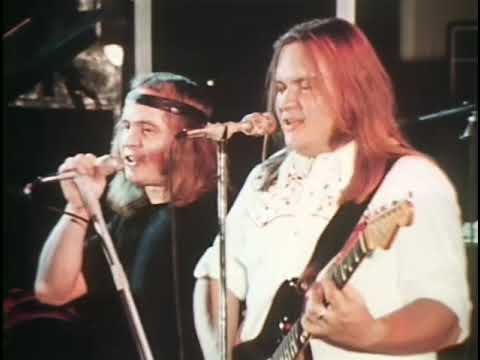
Getting back to Ed King and “Sweet Home Alabama”…this might seem a little too simple, but with the availability of live performance videos and interview content on YouTube you might get some good insight on many of the parts from watching Ed King himself play the piece.
For example:
Whenever I learn a song from an artist I love, I generally do my best to learn it from them in every possible way. Even though an artist might not always play everything live EXACTLY the same way they played it on the record, most players are so idiosyncratic that they DO repeat key licks and the majority of parts the same way live as they did on the records. This is fundamental to my study process.
This is just me though…a lot of times people want to come up with a way to play things that they think would be more logical or more efficient than the way artist that they are studying actually played it. To me, it makes sense to really learn to play it the way the artist played it regardless. I don’t begrudge anyone that wants to figure out a different way to play a piece than the way the artist played it…you can decide how little or how much you want to learn from the person you are studying. Some people want to learn as little as possible and then improv over everything as much as is humanly possible…which is great. It is cool to do that as that is kind’ve the way jazzers approach learning because improvisation is generally considered king and learning anything exactly as it was originally recorded or performed is pretty well anathema. There’s room for all kinds of approaches.
I’ve personally come to the conclusion that bringing up classical musical pedagogy vs electric guitar technique (or what I’ll more broadly categorise as ‘vernacular music’) is a false equivalence.
We look at the regimented learning system of classical musicians and how they can perform all their repertoire which includes a lot of technically demanding stuff and go “this is what we don’t have as electric guitarists”.
The issue is that classical pedagogy is directly linked to the repertoire of the instrument - classical technique pedagogy on any instrument is directed towards being able to perform the repertoire… and the repertoire is selected to fit what is appropriate for the instrument. It’s a feedback cycle; even new repertoire for violin is typically written to slot into the pre-existing violin technical system. Hell, it’s why arranging music is such a difficult thing - taking something from one instrument and trying to apply it to another will always have problems.
For electric guitar and vernacular music in general, it’s not a given that what people will be trying to learn and play will necessarily work well within one technical scheme - using CTC terminology, someone who is ‘naturally’ a DSX player won’t be able to play like someone who primarily uses USX as their technical scheme without making significant adjustments to the music in question being played.
I think of guitar technique as being like having an expanding toolbox; trying to look for a technique which will work the same for all styles, tempos, etc is like trying to look for a single tool that can replace a saw, a hammer, a screwdriver, pliers, hammers, a woodworking plane…
Anomaly? No, they’re normal, it’s rock that is abnormal.
Right, I view it as a weakness unless there is a compelling reason for it.
Yes, but the question is if this is intentional or accidental… Troy didn’t say. That said, I can guess, as many artists didn’t know that they had escapes, etc., hence it is unlikely that they had such extensive planning.
Is this when Paul plays the blues? He looks like a different guy when he does that. Anyway, I’m delighted that you got to sit (stand?) that close.
So, does it make sense to organically develop in a vacuum and discover that one is DSX, or whatever, or is it better to choose Anton (or whatever) and study and learn those techniques? My guess is that it’s better to start with a proven great teacher in the appropriate style and just study, avoiding future remedial work to make up for a questionable start.
Are you sure? I don’t have a great eye but some people that look similar to me at multiple speeds include YJM, Rick Graham, Anton, and surely many others? Now, I can see certain pieces that can ONLY be played slowly because they’re all DBX (due to 1nps), and that’s fine. I just don’t see what the metaphorical screwdrivers and pliers are.
The entire point of the CtC system is to actually observe the mechanics of picking at a fine enough level to distinguish differences that we couldn’t notice without the use of the Magnet and slow motion footage. For example, the degree of use of the finger joints, the difference between RDT motion and simple deviation, etc.
The above players might not even be aware that they’re doing different things at different speeds because humans don’t have the ability to perceive what they’re doing at that level, they’re only able to perceive the results; CtC has shown plenty of examples of players who think they’re doing one thing but are in fact doing another when the footage is taken.
As for whether it’s better to develop organically, I think that technique should develop based on the vocabulary one is likely to use while playing; someone who wants to sound like Paul Gilbert is going to develop a technical schema that is to a degree similar to Paul Gilbert’s, etc.
I’d say the reverse is true - if it’s a weakness in rock, it’s because there’s a compelling reason for it. If there’s no compelling reason for it being “weaker,” then it doesn’t impact anything so there’s no practical argument to be made it’s a weakness.
As it happens I think there ARE practical arguments to be made that it’s a strength - Andy Wood is a good example here as he tends to favor a double-escaped motion for a lot of his mid-tempo playing and only morphs into a single escape at higher speeds, and this hybrid approach leaves him with a LOT more mid-tempo phrasing options than a pure single escaped one would; his whole style would have to sound different because a directional escape wouldn’t allow him to do a lot of his bluegrass stuff nearly as well; had he been drilled in the gypsy jazz tradition, he’d be a far less versatile player. This gets at your accidental or intentional question, too - I think these approaches develop in relation to vocabulary, and in turn vocabulary develops in relation to what feels easy (see: all Yngwie licks). It’s an organic process, and that’s fine.
On the other side of the coin, Twangsta’s been doing a deep dive on SRV, and his picking choices become a lot more efficient at high tempo, but from a pure mechanical efficiency standpoint, a lot of the giant raked pickstrokes he does don’t make sense at all… but they sound awesome. And the impact of picking choices on tone, which is less relevant (or relevant in different ways, at least, articulation and clarity becomes of utmost importance) at hyper speeds, is a lot more important at slower ones. Gypsy jazz has a highly codified picking technique… but also a relatively codified vocabulary, and a technique optimized for it. It’s not a one-size-fits all approach.
Beyond that, I have a general distrust of dogma for the sake of dogma.
Re: Gilbert, it wasn’t just his blues playing, it was pretty much everything he was picking that WASN’T a fast scale run. It’s just his neutral lower-tempo picking mechanic, and as Gilbert is one of the best escaped downstroke players I’ve personally ever seen, it pretty clearly doesn’t hurt him to not use that approach while picking out melody lines.
That’s sort of the entire genesis of CtC and Troy’s analysis, right? That electric guitar, and in particular notes are sounded by striking strings with a pick, presents unique mechanical challenges that don’t really exist elsewhere in the classical world, when pressing keys of a piano or on a flute or bowing a violin, and even really with fingerstyle guitar, and in particular one of major challenges that a guitar presents at high speed, gettig the pick over a string for string changes, is both unique to picked guitar playing, and doesn’t really have an analogue for any other clasicalyly-taught instrument.
If you were to summarize the problem CtC is trying to solve in just a single sentence, I’d say “getting a guitar pick up and over a string is both a unique problem for the guitar, and one that only exists at high speeds, so how can we solve it?” is a pretty fair attempt.
Basically, the questions you’re posing may seem like self-evident “no” answers to you… but they’re not, and that’s literally the reason this site exists. That’s the crux of our disagreement, I think.
Yeah, I’m honestly not sure HOW I could be more explicit. “The same peice played very fast on a guitar with a pick poses different mechanical challenges than the same piece played slowly, and this site exists entirely because of that problem, which is unique to picked guitar and does not exist for “classical” instruments that do not sound notes with a pick.”
That’s what I just wrote in as few words as I can put it, and if you disagree, then I’m a little confused why you’re a member here.