I don’t typically listen to much music with 7 strings.
Any of y’all enjoy playing 7 strings?

I don’t typically listen to much music with 7 strings.
Any of y’all enjoy playing 7 strings?
I like ‘em, but you should play one first to see if you like them. Just realize that you can do more than just chug on the open low B string - they give you more range in any given position which is good for lead lines, melodies, bass lines, etc.
I still play 6-strings, too, though, so I’m not exclusively a 7-string player. Once you get used to them, it’s not difficult to go back and forth between them.
Yeah I need to start checking them out, I’m interested if seeing if any extra string will help my creative process.
It would be even interesting to get an 8 string that was set up to have one string above the low E string and one string below the high E string.
7s are my personal fave - they’re the best overall range for guitar imo (B standard). I also have an 8, but that’s getting a little ridiculous.
There was definitely a bit of a learning curve for me at first, but that was 20 years ago now. Just try one out and see how it feels.
8-strings are cool, but could be an issue for tuning up. They often need a longer scale length to tighten up the low string, and 25.5” is already too long for a high A string (they tend to break easily). I think you could make it work if you tuned down a full step and then added the highest string as a G rather than an A, though.
Yeah I admit 8s do seem a tad over the top lol.
I think even with the 7 string I’ll be looking for fanned fret extended range style.
The B2 string is good, but going higher than E4 is likely impossible due to materials, I think A4 would constantly snap.
I ask myself the same question on a regular basis 
For me the mail appeal would be to do riffs in the lower register (duh!).
So for now what I did is take one of my 6-string and set it up as a baritone.
I forgot your modeling amp brand but would pitch shifting work
Early morning posting is always dangerous but I’m doing it anyway.
As someone with average-to-small hands, I don’t get much benefit from a seven string (though I have one).
But tuning to B? Hell yeah brother, I wasn’t using frets 20-27 on my high E string much anyway
My groggy, pre-coffee point here is that you don’t actually lose much tuning down. The guitar is already a baritone instrument!
I suspect the advantage in down tuning has more to do with timbre than note lowness (technical term). My personal sweet spot for this is three semitones down (C# standard).
Probably depends on scale length. I think Rusty Cooley used to have a fanned fret 8 that had a high Ab. Sounded cool but kinda thin.
Exactly, and the amount of bending (in semitones) that the string must support. The only practical way to do this IMHO is with another E4 string that gets pitch shifted up +5 semitones.
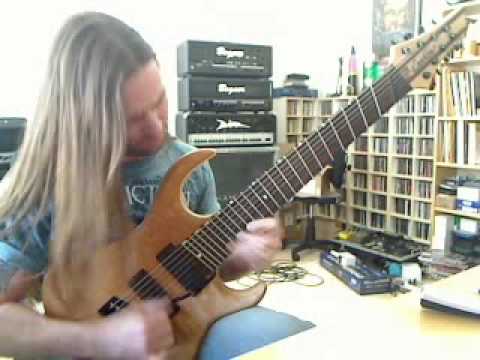
27 frets? dang that’s a lot lol.
I would like a lower and higher string if I had an 8 but I guess, as the other poster pointed out, the higher string might just be too fragile?
Considering getting one of these bad boys. Not too cheap but not expensive either.
https://www.sweetwater.com/store/detail/RGMS7BK--ibanez-rgms7-black
C2# is just above a cello, the most heavy metal instrument of all, so can you drop to C2?
Last year I spent a lot of time debating if I should get an 8 string because 7 did not make sense to me it’s only one more string
so after spending a lot of time trying a few i n store looking for one I finally got one for a very fair price that was not my first choice but it allowed me to get one and see what it actually is
For budget ones I tried Schecter and Cort and honestly the Cort was better fora very good price
They are definitely not as alive as other more expensive brands but for testing this out seriously they are more than enough
I fooled around for a bit but now I’m really spending much more time working on 6 strings there’s so much work on 6 strings already! I feel that 7-8 are great for solo guitar (for the extended range) if you’re more going for lead I’m not sure it’s worth it, to double bass parts / riffs that’s a plus as well.
so I guess it depends on why you think you need one
Ok, I’m a LONG time seven string player. I’ve been on a six string kick lately, I’m not entirely sure why or how it happened but my guess is in fairly short order I got my main Strat back from a much more extended than planned refret, and bought a gorgeous suhr 6 string, and those two guitars just got most of my playing time ever since.
But I like seven strings a whole bunch and don’t think I’ll stop playing them anytime soon, and just because I haven’t written much around a seven string lately doesn’t mean I intend to stop.
Made this video more than a decade ago, as seven strings were starting to hit their second wave of popularity, as a beginner-friendly guide:

Haven’t watched it in about as long now so hopefully it’s aged ok.  But, big observations:
Honestly, unless you’re planning on going well below Drop-A, there isn’t much reason. 25.5" sevens are far easier to find and will give you a lot more options, and a 25.5" scale doesn’t really pose issues at B or even A. It’s when you get to an 8 string that the low F# or E really starts to become a compromise at shorter scales, or the high E a compromise at longer ones. And even then, a guitar amp that sounds good THAT low while sounding good in the normal range is still going to be tricky to find; for me it’s not that an 8 is “too much” while a 7 is “just right” or anything like that (which would make me a hypocrite with the majority of players who feel the same about 7s and 6s) as much as with a distorted amp, an 8 is where you start to push the limits of where a distorted amplifier begins to become a tradeoff. I DO still toy with getting an 8 of some sort for clean touchstyle/fingerstyle stuff, but I’m awful at both so it hasn’t been a priority.
PS - video was from 2012, and looking at it, I feel like I was a CHILD back then. 
but, tl;dr - don’t bother with fanned frets or extended scales, you don’t need them unless you’re doing something really funky with tuning. And, the real upside of a seven string isn’t the absolute change in range, it’s the change in range in any single playing position.
Very useful information, thanks.
Particularly the part about the scale length.
Seriously, you DO start to have tradeoffs as you go lower… but I HAVE tuned a 25.5" seven down to E, and it’s laughable even with heavy strings but it DOES work.
And this becomes a lot more true when you’re not bashing away on the low B - for much of the playing range of the guitar, you’ll likely be more comfortable on a fixed-scale 25.5", and even the lowest few notes, low B or low A is totally fine with “normal” string gauges.
In a vacuum I might prefer something a hair heavier, but these days I just stock Elixir 10s, stock, rather than a six string set and a custom low B. It’s not worth the extra hassle and expense, I think, and a 56 DOES work well enough in B.
ZERO regrets about the 7 string. Ever try to play in Eb? Now I can do it.