
My fretting hand is ok with it. I did have issues at one point but have been working on my legato so that with this particular line it’s the right hand that is struggling
Stuff like this is DEFINITELY a challenge. You are not alone!
3 Likes
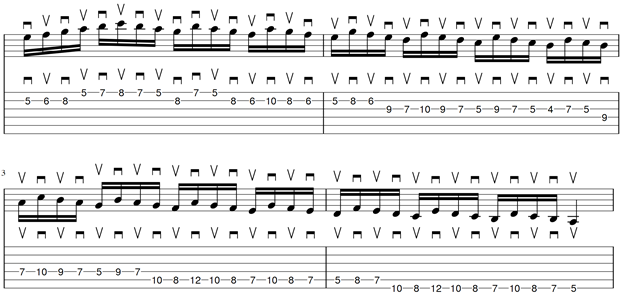
How’s this? Other than the one swipe and one sweep in the first measure it’s all DWPS. The position shifts are what’s comfortable to me but they should be easy to move around.
2 Likes
2nd semiquaver of beat 2 can also be an upstroke, but I like the tone of this Yngwie-sort of solution.
For alternate picking OP, there are three steps to the lick:
- Beat 1: 3 notes on one string, 1 note on the next = some UWPS in the string transition between 3rd and 4th note
- Beat 2: 2 notes + two notes = DWPS
- Beat 3: 1 note + 3 notes = some UWPS in the string transition between 1st and 2nd notes…
…and repeat in the next string pair.
If you’re Achilles heel is the inside string changes in steps one and 3, you only have one problem to focus on to make the whole pattern work, so I’d devise exercises that purposefully and exaggeratedly address that one thing, and then bring the rest of the pattern in.
2 Likes
I think most people feel more comfortable with ascending.
For me, I think it was just neglecting to ever learn ascending outside picking… when I started with 2WPS… I’d use it for descending inside picking… but I didnt much use it for ascending… instead I kept defaulting to economy picking whenever I was ascending. So its been years of neglect for me… and now Im trying to make up for it.
1 Like
Yes, I was thinking I’d have to try it in pieces. The first ‘chunk’ of 8 notes or so I can do pretty quickly and cycle through again from the start but the second part after those 8 notes is usually where it falls apart for me
Part of the overall difficulty I think comes from the slant changes appearing at irregular intervals so it isn’t as predictable as it should be.
1 Like
They’re not irregular though. There’s 12 notes to the pattern and the slant changes happen at notes 3-4 and 9-10 every time. If you think of the lick as being in 3/4 you might sense the pattern more intuitively.
1 Like
Yes, that’s true but the way it starts there’s a double slant that doesn’t occur elsewhere. I suppose repeating the first 3 notes would eliminate that first slant change and make it entirely regular
1 Like
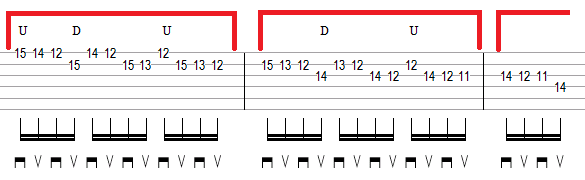
That’s another reason to start with UWPS. Not only it removes the double slant change, but it also makes the pattern completely consistent.
EDIT: This should make it clear.
2 Likes
I might have misunderstood, but I don’t think that does remove the double slant. You still have 3 notes on the first string which requires a change in slant, followed by a single note on the 2nd string, which again needs a slant change. Starting with UWPS would just reverse which parts of the pattern are DWPS or UWPS. Someone else might want to check my thinking is right here.
Edit: I get it now. It’s because of starting with a downstroke when using UWPS. I think starting with an upstroke when DWPS would have a similar effect (in reverse)
1 Like
That’s what I meant, yes. I probably should have clarified that. Starting with DWPS and an upstroke should be similar, the difference being that the string changes that require a slant change would be outside. That’s less comfortable for me, but it might work better for others.
1 Like
There’s (hopefully) a happy end to this story.
Since posting, which prompted me to sit down and work out what the slant changes were meant to be, I’ve realised I wasn’t putting them in the right spot, as well as not doing the quick double slant at the start.
I’ve since been working slowly on getting it right and have brought my upper limit of cleanly playing it from about 135 or 140 bpm up to 150 or so. It’s not yet up to where I’d like it, but that’s progress after a week or so of a frustrating lack of improvement.
Thanks for all the encouragement and suggestions. I’ll give some of the other methods suggested a try too and see which works out best.
1 Like
here’s some discoveries I’ve made I will try to summarize re asc and dsc 4 patterns:
- when playing a strict asc or dsc 4’s patterns, as Sorc described, you start w UWPS and alternate your pickslant exactly as he showed in his diagram, the same exact procedure also works ascending.
- you can start #1 with DWPS either dsc or asc too as mentioned, but you must then start with an upstroke
- if you prefer to start a 4’s pattern w a DWPS on a downstroke, you must alter the pattern sequence by adding say 1 or 3 notes to the start of the strict 4’s pattern like:
D_________U___________D
- 12 15 14 12----14 12 ---------12
----------------- 15---------15 13—15 13 12
or
15 14 12 15 14 12
----------------------- 15 etc - the ascending version of this works exactly the same starting w DWPS and a downstroke for ex:
D ________U__________D
----------------10--------10 12----10 12 14…etc
14 10 12 14----12 14-------- 14
- #1 can also be played as described in Antigravity, with a UWSW (upward swipe)+ (upstroke start) for a strict descending 4’s 3nps scale…and with a DWSW (downstroke start) for a strict ascending 4’s 3nps scale
sorry for the ghetto presentation…maybe this helps somebody crack this age-old dilemma; I’ve been working on this for about a year and it finally seems to be sinking in…
1 Like
A great exercise for developing descending fours could be the “Smoke Signals solo” from Nuno Bettencourt. I am not 100% sure if he picks every note on the record and it´s pretty fast (try to play that solo picking every note, I think it´s a great (and funny) exercise).
There is an early live version on YouTube when Extreme played live in Azores in 1987. I´ve never seen Nuno play that lick again in a live situation (maybe at the end of “Play with me”)
Anyway, descending fours is always a quite challenging lick and Troy helped us a lot in this area!
1 Like
Thanx a bunch!!! that REALLY worked for me. I always used to start this pattern with a downstroke + DWPS with a tendency to miss the third note. 
1 Like
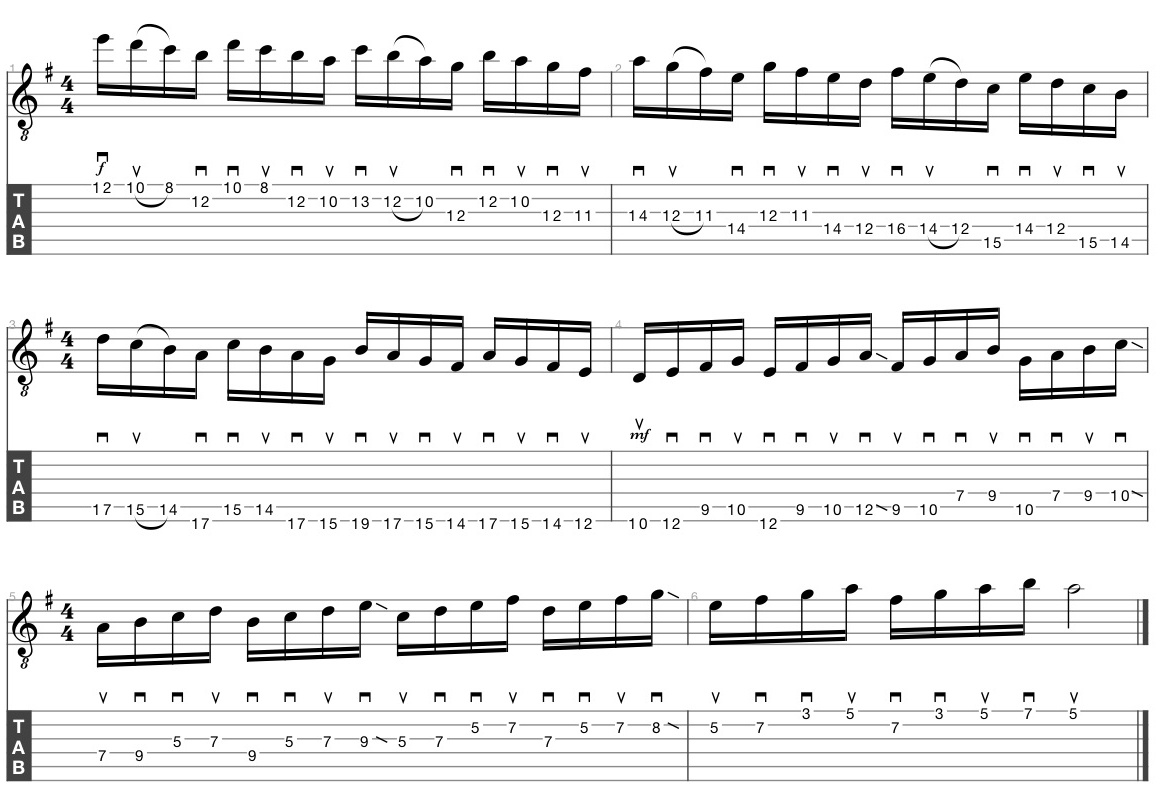
The sole note on the first string that starts the 3rd set of four notes is the problem, at least for me. I have to either change pick slant to catch this note or precede it with a pulloff on the second string that give the pick time to loop around for the requisite upstroke, both of which “breaks the rule”. I played around with eliminating that note and this is what I came up with. It shifts up to the problem note on the second string and the cycle repeats. It preserves DWP and, oddly, moves up the neck as it descends (and vice versa).
1 Like
It’s been two years since I started this thread and funnily enough was playing this lick just today. For those still having trouble, practice does eventually pay off- I can play it up to about 175-180bpm now.
The interesting thing is, I don’t think it was practicing this specific lick that got me there. It was more learning the mechanics. I recommend the ‘punisher’ lick that Ben Eller has as a warmup (see YouTube). That got me practicing the string switching moves quickly which can then be applied elsewhere.
1 Like
I’m new to pickslanting and have been struggling to think how to apply it to Ben Eller’s “The Punsher”. How do you manage? I can’t think of any way that will end back where you started with the pick when you get to the next 1-2-3-4 sequence on the next string.
1 Like
The punisher involves all the possible directions for pickslanting. Assuming you’re a USX player (I still struggle with this new terminology) starting with a downstroke, the first four notes on the thickest E string just require the same USX motion, but after the 5th note, which is the first note on the A string, a change in pickslant is then required to come back to the E string for the 6th note, then you play 3 notes on the 6th string, which is an odd number, so again the pickslant flips (back to the original USX direction, although in practice I flip immediately back), then you play another 2 notes on the A string (and even number, so no need for a change in slant), then back to the E string for another 2 notes (again, no change), then 3 notes on the A string (odd number, so a change), then 1 on the E string so again flips slant, then the final 4 notes are back to USX.
Then the whole pattern repeats on the A and D strings and then the next two.
Hard to explain. Much easier to watch the video or just do it. With time it becomes automatic and I’ve found the skill extends to other patterns so I don’t really need to think about it now.
1 Like
I also mixed things up with it. Play it descending, play it as triplets with accents (much harder), play it starting on an offbeat. All of this then trains you in multiple skills at once (timing/rhythm, accenting and pickslanting).