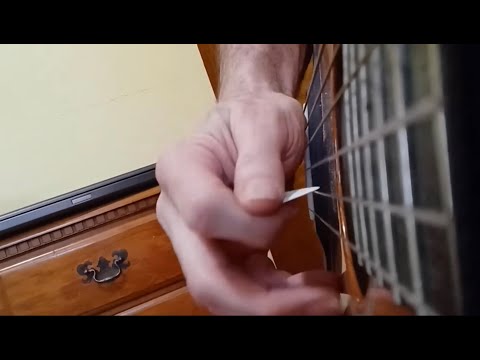
I’ve been trying to drill my wrist and build up a reliable picking technique. It feels like I’m using my wrist, and I’ve been trying to roll up my sleeve to plant my arm onto the guitar body, but after taking some video and slowing it down, it looks like I can’t help but add some elbow when I’m speeding up, unless that’s just forearm rotation or somewhat normal?
I’ve been trying to drill it for weeks… Trying to pick softly the faster I go, letting myself dig in, etc. I just mainly try to minimize tension, but it’s slow gains on building endurance and speed. I would say on a good day I could maybe do 16th notes at 170 - 180 bpm constantly for about a minute tops. I’ve been chilling out and taking a break if I try to open up too fast and let the tension build.
Anyways, I’m definitely looking for thoughts/feedback, just a quick and dirty video I took for myself to try to see what’s going on:
Definitely using the elbow, I think it might be a mix of wrist and elbow
If it was working reliably for me I would say that it does not matter. I’m trying to build up endurance and reliability to just improve the technique overall
For whatever reason it’s pretty difficult to isolate my wrist and get any speed with it
I think the issue is that it can fool beginning players and laypeople into thinking spamming elbow technique is actually good.
Not to say that’s what OP is doing, just saying that I tend to look down on people who lazily adopt elbow picking as the primary driver of their motion without properly practicing wrist/forearm picking.
I’m specifically trying to solve my wrist picking, that’s why I created the topic!
To reiterate, it seems that whenever I speed up, my elbow gets involved. Technically I should be able to isolate my wrist without too much practice and just pick 16th notes at 130-170+ bpm even if it’s not rhythmically locked in, right? It’s somewhere around the beginning of that range where the elbow makes an appearance for me.
It feels like I could drill my wrist in that BPM range for weeks trying to pay close attention to not letting the elbow get involved, and still not make gains.
This may sound primitive as fuck and is by no means pedagogy, lmao, but when I was working on isolating wrist movement (as a former horrible elbow picker) I would literally hold my arm right behind the wrist (with the right hand in the picking position on the guitar) and move my wrist in an isolated fashion to get used to how it distinctly felt.
Another thing that really helped me suss things out with my wrist vs elbow distinction was speed bursting. Just setting the metronome and doing separated quintuplets on a single string really helped for some reason. I think it’s because at the start of every short burst seems to be a “reset” for the brain and hands versus doing much longer sequences of notes to the metronome where your brain clouds over and goes on auto-pilot.
All of the parts of the arm (and shoulder) are connected and offer something that we can use while playing guitar. Trying to completely isolate one movement from all the others is unnatural and doesn’t make any sense.
Remember, we’re doing this to ultimately make music, and the ability to make music should be the criteria by which we judge our technique. While I think that trying to limit yourself can be useful for practice (by forcing your body to occupy certain parts of the overall solution space and causing your brain to realise you have more options available to you), you shouldn’t let non-musical considerations dictate your technique.
There’s not legitimate reason not to use the elbow. Many great players have some elbow involvement at quicker tempos (John Petrucci as one example) and others primarily use their elbow (Vinnie Moore). Tell me they’re lazy or worthy of being looked down on.
Nuno Bettencourt states that he wears his guitar much lower on stage than he is actually comfortable with and that it compromises his playing ability but he does it because it looks cool.
I’m just saying there’s something about technique looking good. Tell me you don’t find a world class concert pianist’s hands and fingers pleasing to observe in execution.
One of the issues with me when it comes to guitar is how much variance there can be in accepted technique whereas in classical instruments, with a pedagogical approach towards technique that has been optimized over history, there tends to be much more of a uniform appearance to how their technique looks in execution.
I think this is one of the reasons guitarists are a “dime a dozen”. Because the bar is just objectively lower for guitar than it is for many other instruments.
Too many players can hide their insufficient command over technical aspects of guitar that just wouldn’t be acceptable for classical instruments past a certain level.
John Petrucci used to be primarily a wrist picker and he was much better and cleaner during that time imo.
Vinnie Moore is a fucking anomaly in that he sounded worse after he stopped doing elbow picking and switched primarily to wrist picking - but let’s be real, the dude is a bit of a unicorn in terms of how precise he was while still using elbow picking to that degree.
The video isn’t working for me, but to the OP I see no reason why you can’t develop wrist-based motion up to around the 170bpm - 180bpm you referenced. That’s a good tempo, especially if you can do mixed escape lines at that tempo. Having said that, I feel like isolated movements have a lower ceiling, so 170bpm - 180bpm is around the limit for most.
Movements rarely happen in isolation; this has been covered by Troy and others. Many ‘wristy’ players have some visual forearm/elbow movement at higher tempos. Remember, you have wrist muscles/connections that are above the elbow - hence, the majority of players have a ‘combined’ movement.
In fact, I’d love to see someone blast tremolo above 200bpm without some visible combination movement. I can think of one - Spiro, and even he has mentioned he feels some arm involvement at higher tempos.
Eh, while there might be some slight visible motion to the arm caused by the wrist if the wrist is the primary motor of movement but just 200bpm with only wrist movement isn’t that difficult imo.
There are plenty of players who could do that - young petrucci, paul gilbert, nuno, young eric johnson, etc.
Sure there might be a little elbow movement here and there due to the wrist action but clearly the primary engine of movement here is the wrist and there are clearly times when only the wrist is really moving and this is well over 200bpm.
Whereas OP, no insult, clearly has the motion coming from the elbow.
It does seems valuable to isolate different movements to be able to train them to develop control. I know this thread seems to have largely turned into a debate where everyone has their own take, and that is largely in the spirit of what Troy Grady advocates from what I’ve gathered. Due to differences in physiology, genetics, etc. the same movement won’t necessarily work for everyone.
My rationale is isolating movements for practice will potentially have significant value because if they’re trained in isolation and developed, as long as they aren’t incompatible or too divergent, you could then drill combining them for a better result rather than trying to brute force a large combination. My obstacle, like most people, is tension, and being able to mix things up a bit will probably allow a bit of tension release. You make a good point that the real goal is music (for most of us) - and that is not at odds with my goal. I’ve heard it put that technique is essentially just speech therapy to get there.
Appreciate the input from everyone
I think so too, working on it! I think/hope that taking the slow motion video to see what was really going on will be valuable. I seem to have gotten the movement a bit more warmed up yesterday, and while it’s not tension-less, it feels better to me and hopefully that continues if I can isolate it at higher BPMs
I agree it seems relatively rare - I just saw this the other day. Definitely some elbow involved (less than/smaller movements than what I was doing), it doesn’t seem to be a detriment given how much endurance he has.
I think my issue is that when it comes to classical instruments with established pedagogy in terms of technique you don’t see this much variance despite differences in physiology.
I really do think plectrum-based guitar technique needs to evolve towards a “universal” and more singular approach, but obviously that’s just my opinion.